Monday, October 31, 2011

Your Pledge Dollars at Work: The Episcopal Church Socialist League

From the Diocese of Minnesota, where they had to get their fireplaces going early this week, comes this interesting use for church buildings:
The "Episcopal Church Socialist League" will meet on Nov. 7, 2011 at St. Paul's Episcopal Church on-the-Hill. An Episcopal Socialist League? What will they come up with next?

The announcement states,
"This group has grown organically at St. Paul's out of a deep desire to ground the transformation of society both in the liturgical life of the church and her rich history in this area.
Our next meeting will be on Monday, November 7th at 7:15pm at St Paul's Episcopal Church on-the-Hill. All are welcome to come bring their ideas on what action they would like to see the ECSL engage in this upcoming year"

I could not find this event on the on-line church calendar for St. Paul's church on-the-Hill, but after a perusal of their web page, I would not doubt that the Episcopal Socialist League will meet and will be welcome because the church's home page advertises (among other things) "Radical Hospitality," and
"We relish a good debate and a great vegan meal, or a BBQ in the summer. We engage in mission with our sister congregation El Santo NiƱo Jesus. We are learning still, after better than ten years, what that means to be brothers and sisters in Christ. Come learn with us.

The people of St. Paul's have a strong tradition involvement in peace and social justice issues rooted in our heritage as an progressive Anglo-catholic parish in The Episcopal Diocese of Minnesota(see Justice).

We also are a people who believes in excellence in worship (see Worship). We know from our tradition that there are many ways to worship and so we offer Solemn High liturgies with chanting, incense, and full choir as well as simiple contemplative liturgies in a wide range of styles. Festive receptions often follow our liturgies as a place to meet and greet.

Our vision as a Christian community is rooted in four areas:

+ Radical Hospitality+

+Inspiring Worship+

+Spiritual Formation+

+Passionate Advocacy+

These areas are the tap roots of our life in Christ. Because life is a process, we are learning what this mission means one day at a time. Want to know more? Come and see!"

Blessings & Peace,The Rev. Mark Thompson, Vicar


The web site has links to recent blog posts which include "Read up on "homosexuality and the Bible" - Fr. Neil" which left me rolling my eyes when I read,
"Finally: Romans 1:24-27 gets inordinate attention in all discussions of "the Bible and homosexuality," and almost always is read as Paul's theological diagnosis of the homosexual "condition." I think that reading is fundamentally wrong. I've discussed the passage in two books (Liberating Paul [1994; 2006], pp. 192-94, and The Arrogance of Nations: Reading Romans in the Shadow of Empire [2008], 75-83), and in summary form in this 2003 column on "The Apostle Paul and sexuality" at The Witness online (click here).

What do other scholars think about that argument? One attempt at rebuttal, from Robert A. Gagnon, is here (to which I will respond in another post). Since the publication of The Arrogance of Nations, I've heard from other scholars (okay, a total of three so far) who find the argument "completely convincing": "it convinced our whole graduate seminar on Romans"; "it blew my socks off." That argument was the hook for the brief mention of my book in Lisa Miller's cover story on gay marriage, "Our Mutual Joy," in Newsweek, Dec. 15, 2008. But of course being mentioned in Newsweek only guarantees that I'll be vilified by a wider circle of conservative Christians--not that I'm right.

Grace and peace,

Fr. Neil" (2009)
I would bet dollars to donuts that Robert Gagnon would destroy this guy in a debate, but the "occupy St. Paul's on-the-hill" crowd would probably not let that happen.

I do not doubt that St. Paul's on-the-Hill is full of loving people who are unaware that they have been occupied by not only socialists but by Biblical revisionists.

I hope the Socialists will confine their activities to polite debate on the scriptural basis of socialism and not say a single word that might suggest that the church on-the-Hill endorses a political party or candidate. After all, that might jeopardize the tax exempt status of the church.

Good luck with the stewardship campaign St. Paul's-St. Paul, Mn! From the stats it looks like you are going to need it!


After 3 blog posts in 2 days, the socialist in me tells me that I shouldn't put in any more hours of work on this blog this week.

Yes Virginia, There Really is a Boogerman

"People travel to wonder at the height of the mountains, at the huge waves of the seas, at the long course of the rivers, at the vast compass of the ocean, at the circular motion of the stars, and yet they pass by themselves without wondering."-St. Augustine.


Teacher: "What do you want to be when you grow up Robbie?"

Robbie: "I want to be the Boogerman!"

Classmates: "Guess who has a new nickname?"

That was the case for Robert Palmer who would carry that nickname throughout his lifetime and beyond.

It was my intention a few years ago to hike the Boogerman Trail in the Great Smokey Mountains National Park. I just couldn't resist the name.

Marti Davis at m.knoxnews.com had this to say about the area of the trail,
"This area is named for one of the first hardy families to populate the rich but remote Cataloochee Valley. According to Ken Wise, author of the irreplaceable 'Hiking Trails of the Great Smoky Mountains,' a Confederate deserter-turned-Union renegade raider entered the valley near the end of the Civil War, seeking out suspected Confederate sympathizers Levi Shelton and Ellsworth Caldwell. Kirk's marauders proceeded up Caldwell Fork and whipped the women, who nevertheless remained silent. Undaunted, the Union renegades waited until dark, then followed the women to the lair of their mates and executed them. They were later buried on a hillside overlooking Caldwell Fork Trail.

The story behind the Boogerman Trail's name is a far less grisly story that begins on the first day of school for a local boy, painfully shy Robert Palmer. When the teacher asked his name, the tongue-tied Palmer finally blurted out 'Boogerman,' and the name stuck and he was christened 'Booger' Palmer. He later left the crowded farmland of the Cataloochee Valley to seek a lonelier home place along the trail that now bears his name."

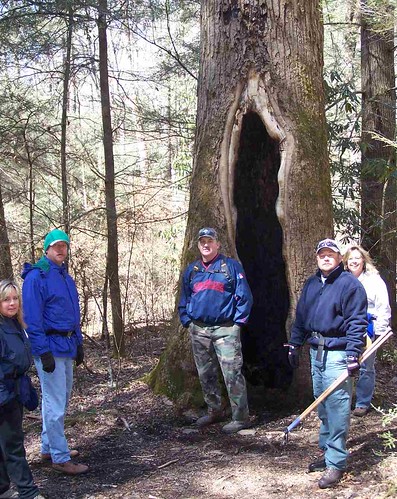
Back in '96 we camped at Cataloochee the night before hiking the Boogerman. The forecast was typical for a Smokey Mountains camping trip, so we were prepared for wet weather. Intermittent drizzle did not slow us down as we hiked to Boogerman's place. We did take shelter briefly in a tree. I did not take any pictures because of the rain, but others have photographed that tree, and here is one I found at flickr,


Part of the trail from the campground was also a horse trail so our boots took on a pleasant natural "flavor" as we tried to dodge the barn apples before angling off onto Mr. Palmer's trail.

We never found the Boogerman, but we did spot a fragment of a cast iron pot in one of the creeks and imagined this as being one of Boogerman's very own cooking pots. Just what did he like to cook, little boys and girls, or maybe possum stew?

We also found a crawfish by the creek. I wonder if Booger ate those?

Here are my original notes from back in 1996:

This trip to the Boogerman trail looked like a complete rainout from the forecast, but I hoped we would be lucky and only get rain at night.
We left Rock Hill at 4:30 p.m. We took exit 20 from I-40 and had to turn right not 200 yards off the interstate toward Cataloochee campground. It was getting dark by this time and the road turned into a gravel one that snaked up the mountain for what seemed like an eternity but eventually emerged on a ridge where there was a paved 2 lane road. A few more miles and we were relieved to find the campground after entering the park. It was after 7:30 when we arrived and we had to set up our tents and make some hot chocolate. This time we set up a canopy over the tents to keep out the rain which was a good idea since it rained pretty hard that night. One side of the canopy pulled loose but we stayed dry. Every time I woke and heard rain, I had to make sure that it really was rain hitting the side of the tent since one of the kids had been known to obey the call of nature standing inside the tent.

The next morning, the rain had stopped. After a breakfast of bacon and pancakes, we hiked 0.8 miles down Caldwell Fork trail to the junction with the 3.8 mile Boogerman trail. Passing through a rhododendron thicket we noticed several good walking sticks. We passed several downed trees which appeared to show the face of the Boogerman formed by “natural” processes smiling at us. We found his farm land and an old cast iron pot. There were several crawfish burrowing in the path near here. As we left this bottom land we stopped at an old split rail fence to eat lunch and take some pictures. We then set off on our homeward leg, and it started to rain hard after we found a large stone wall.

It rained the rest of the way back to camp. When we joined Caldwell Fork trail again we had 2.8 miles downhill to go on a horse trail that had numerous mud holes and at least 12 footlog creek crossings. We learned what a Fraser magnolia was and what “barn apples” were. We found that a poncho will keep your upper half dry only if you wear the hood. Even though one kid walked straight through every puddle, my boots were just as soaked as his when we got back to camp. The hike was 7.4 miles, took 5 and a half hours, and the F.i.L. commented that not once did the children complain. They seemed to enjoy it all the more because of the circumstances. After the hike the F.i.L. took a nap while we got dry, and hid out in my tent because it was still raining and getting colder. We practiced our knots while before starting a pot of soup when the rain slowed down. The rain stopped before sundown, and we decided to try to build a fire. Anyone can start a fire with dry wood, but it takes a real scout to start one with wet wood. Not even the F.i.L. could not get it going until N1S pointed out the “fat wood” that he had brought along. This helped immensely, and allowed us to dry wood over the new fire. We toasted marshmallows, and warmed up by the fire before going to bed. We all slept well that night.

09-29-96
We got up at 7:30 a.m. and ate a good stack of pancakes before driving home. We had quite a mess of wet camping equipment, boots, and clothes to dry out once we got home.


Sunday, October 30, 2011

Pride and The Lectionary Editor

Today's supply priest gave a very good sermon on the subject of "Pride" based on Matthew 23:1-12.

I was thinking about how our pride shapes how we read the Bible. We tend to ignore the parts that we don't like and focus on the parts that please us.

Many times the lectionary does this for us by presenting us with the expurgated Bible as has been pointed out on this blog as well as over at the Churchmouse blog.

Today's lectionary provided another cleaned up Psalm for the Sunday masses. This time, Psalm 107 felt the chopping block. The result was a "psalmette" that left me feeling warm and fuzzy, and I don't do warm and fuzzy. This is what we read:
1 O give thanks to the Lord, for he is good;
for his steadfast love endures for ever.
2 Let the redeemed of the Lord say so,
those he redeemed from trouble
3 and gathered in from the lands,
from the east and from the west, from the north and from the south.
4 Some wandered in desert wastes,
finding no way to an inhabited town;
5 hungry and thirsty,
their soul fainted within them.
6 Then they cried to the Lord in their trouble,
and he delivered them from their distress;
7 he led them by a straight way,
until they reached an inhabited town.
33 He turns rivers into a desert,
springs of water into thirsty ground,
34 a fruitful land into a salty waste,
because of the wickedness of its inhabitants.
35 He turns a desert into pools of water,
a parched land into springs of water.
36 And there he lets the hungry live,
and they establish a town to live in;
37 they sow fields, and plant vineyards,
and get a fruitful yield.
Lots of good vibes in that one, but I was left wondering about verses 8-32 and why they got left out. After all, they contained the following,
8 Let them thank the Lord for his steadfast love,
for his wonderful works to humankind.

9 For he satisfies the thirsty,
and the hungry he fills with good things.
10 Some sat in darkness and in gloom,
prisoners in misery and in irons,
11 for they had rebelled against the words of God,
and spurned the counsel of the Most High.
12 Their hearts were bowed down with hard labour;
they fell down, with no one to help.
13 Then they cried to the Lord in their trouble,
and he saved them from their distress;
14 he brought them out of darkness and gloom,
and broke their bonds asunder.
15 Let them thank the Lord for his steadfast love,
for his wonderful works to humankind.
16 For he shatters the doors of bronze,
and cuts in two the bars of iron.

17 Some were sick through their sinful ways,
and because of their iniquities endured affliction;
18 they loathed any kind of food,
and they drew near to the gates of death.
19 Then they cried to the Lord in their trouble,
and he saved them from their distress;
20 he sent out his word and healed them,
and delivered them from destruction.

21 Let them thank the Lord for his steadfast love,
for his wonderful works to humankind.
22 And let them offer thanksgiving sacrifices,
and tell of his deeds with songs of joy.
23 Some went down to the sea in ships,
doing business on the mighty waters;
24 they saw the deeds of the Lord,
his wondrous works in the deep.

25 For he commanded and raised the stormy wind,
which lifted up the waves of the sea.
26 They mounted up to heaven, they went down to the depths;
their courage melted away in their calamity;
27 they reeled and staggered like drunkards,
and were at their wits’ end.
28 Then they cried to the Lord in their trouble,
and he brought them out from their distress;
29 he made the storm be still,
and the waves of the sea were hushed.
30 Then they were glad because they had quiet,
and he brought them to their desired haven.

31 Let them thank the Lord for his steadfast love,
for his wonderful works to humankind.
32 Let them extol him in the congregation of the people,
and praise him in the assembly of the elders.
Granted, Psalm 107 might seem a tad bit too long for a Sunday morning service, but it looks like the part that was cut is the part containing lots more great reasons why we should be so thankful to the Lord.

Verses 9-16 give us a recitation of the reasons for the distress of the people: Thirst, hunger, imprisonment, hard labour. Bless the Lord who relieves all who so suffer.

Verses 17-20 describe the sickness the people suffer as a result of sin. This would be an obvious choice for the lectionary committee to cut because it is not at all in keeping with the modern world view. I like it, and think we are sick with sin, and therefore I see no problem with presenting this subject to the Sunday morning crowd.

Verses 23-30 give us a wonderful premonition of Jesus calming the stormy sea. I really think that should have been heard.

Verses 31-32 conclude that because of God's great deeds of saving grace we are to shout about it in the congregation, not cut it out and leave it to some lowly blogger to dredge up in a half forgotten part of the web.

To be fair, Psalm 107 goes on for five more verses at the end, but the only objectional lines are the "negative" things God does to princes and wickedness.
38 By his blessing they multiply greatly,
and he does not let their cattle decrease.
39 When they are diminished and brought low
through oppression, trouble, and sorrow,
40 he pours contempt on princes
and makes them wander in trackless wastes;
41 but he raises up the needy out of distress,
and makes their families like flocks.
42 The upright see it and are glad;
and all wickedness stops its mouth.
43 Let those who are wise give heed to these things,
and consider the steadfast love of the Lord.
At the risk of repeating myself, when we cut and paste the scripture to either make worship more pleasurable or in order to direct the message rather than let the message direct us, we are guilty of the cardinal sin of pride, and we are giving people a watered down version of Christianity which does them no favors.

Wednesday, October 26, 2011

Would Glasses or a Hearing Aid Help?


This past Sunday, at about minute 15 of the announcements, I lost all sense of being in church and in the presence of the Lord. I forced myself to close my eyes and ears in order to shut out all the thoughts of the places I had to go and the things I had to do that day. It worked, but I had to keep coming back to these old tried and true methods of quieting the mind in order to get through the rest of the service. Today's Gospel reading, Matthew 13:10-17, is helping me get back in focus.
Then the disciples came and asked him, ‘Why do you speak to them in parables?’ He answered, ‘To you it has been given to know the secrets of the kingdom of heaven, but to them it has not been given. For to those who have, more will be given, and they will have an abundance; but from those who have nothing, even what they have will be taken away. The reason I speak to them in parables is that “seeing they do not perceive, and hearing they do not listen, nor do they understand.” With them indeed is fulfilled the prophecy of Isaiah that says: “You will indeed listen, but never understand, and you will indeed look, but never perceive. For this people’s heart has grown dull, and their ears are hard of hearing, and they have shut their eyes; so that they might not look with their eyes, and listen with their ears, and understand with their heart and turn— and I would heal them.” But blessed are your eyes, for they see, and your ears, for they hear. Truly I tell you, many prophets and righteous people longed to see what you see, but did not see it, and to hear what you hear, but did not hear it.
The disciples were blessed to be in His presence, but not everyone who met Jesus saw or heard Him at the time. How do we obtain those blessed eyes and ears of which Jesus speaks? We like to think that one of the problems with modernity that keeps us from hearing God's call is the incessant noise of the information age. Even to those of us who do not have ADHD, work and the distractions of the ever increasing sources of entertainment available to please us can effectively drown out the voice of God. No, glasses or a hearing aid would just amplify the noise.

 Should we blame the computer, the television, or the bloggers for our walk apart from the Lord?

 What if we follow John Prine's advice?
"Turn off the T.V. Throw away your paper. Move to the country. Build you a home. Plant a little garden. Eat a lot of peaches. Try an find Jesus on your own." - "Spanish Pipedream" John Prine 1971
I am not sure if that would work either, but it might be a good start. Maybe it isn't the noise from the world that is the problem, maybe it is us, and we shouldn't blame the world because we don't connect with God. Maybe the problem lies between our ears. But just in case, would somebody please pass me the peaches?

Sunday, October 23, 2011

Who is DUSC's Neighbor?

Yesterday we witnessed the annual Convention of the Diocese of Upper South Carolina put forth a resolution suggesting an alternative means of reconcilation between our Presiding Bishop and Bishop Mark Lawrence of the Diocese of South Carolina (yes there is another Episcopal diocese in South Carolina). (Update: the resolution is now posted at StandFirm in Faith) An impassioned Bishop Andrew Waldo of Upper South Carolina argued before the Convention for the benefits of a Christian manner of handling a difference of opinion (as opposed to the use of disciplinary canons). By an odd Godincidence, the Gospel reading for today begs the question, "Who is your neighbor?" Matthew 22:34-46
When the Pharisees heard that he had silenced the Sadducees, they gathered together, and one of them, a lawyer, asked him a question to test him. Teacher, which commandment in the law is the greatest?’ He said to him, ‘ “You shall love the Lord your God with all your heart, and with all your soul, and with all your mind.” This is the greatest and first commandment. And a second is like it: “You shall love your neighbour as yourself.” On these two commandments hang all the law and the prophets.’ Now while the Pharisees were gathered together, Jesus asked them this question: ‘What do you think of the Messiah?* Whose son is he?’ They said to him, ‘The son of David.’ He said to them, ‘How is it then that David by the Spirit* calls him Lord, saying, “The Lord said to my Lord, ‘Sit at my right hand, until I put your enemies under your feet’ ”? If David thus calls him Lord, how can he be his son?’ No one was able to give him an answer, nor from that day did anyone dare to ask him any more questions.
Yesterday the people of Upper South Carolina let it be known just who is their neighbor. Will former Bishop of DUSC, Dorsey Henderson, who is in charge of the disciplinary committee judging +Mark Lawrence of DSC, be able to give our Lord an answer to the question, "Who is your neighbor?"

Wednesday, October 19, 2011

Healthy Doubt vs Unhealthy Doubt

Yesterday, StandFirminFaith pointed out a support group for non-believing clergy,
"The Clergy Project is a confidential online community for active and former clergy who do not hold the supernatural beliefs of their religious traditions. The Clergy Project launched on March 21st, 2011. 
Currently, the community's nearly 100 members use it to network and discuss what it's like being an unbelieving leader in a religious community. The Clergy Project’s goal is to support members as they move beyond faith."
I am not sure what "moving beyond faith" means to the leaders of the support group, but it does not sound like a direction in which clerics should be supported.

Let's face it, we all have our doubts. We all have our own ways of dealing with those doubts. There are some ways which are healthy and some which are unhealthy. The difficulty comes in telling when you are following the path to health because the unhealthy path often appears to offer the most tempting message and the tastiest meal. In fact, skepticism has such a following that it has become a great vehicle for making a name for oneself, landing an academic appointment, or getting a book published. There is even an emerging name for the phenomenon, "Emergent Skepticism," although it is sometimes referred to as "liberal skepticism." From what I can tell, emergent skepticism leads to unhealthy doubt.

From Fors Clavigera (H/T Treading Grain),
"But there is also an important difference between emergent skeptics and catholic doubters: The new kind of skeptics want the faith to be cut down to the size of their doubt, to conform to their suspicions. Doubt is taken to be sufficient warrant for jettisoning what occasions our disbelief and discomfort, cutting a scandalizing God down to the size of our believing. For the new doubters, if I can't believe it, it can't be true. If orthodoxy is unbelievable, then let's come up with a rendition we can believe in."
I am not sure that the emergent skeptics really know what they want, but in the long run, their "unhealthy doubt" has a corrosive effect on that person's relationship with God, and if promoted publicly in Sunday school classes or from the pulpit, such "unhealthy belief" has a corrosive effect on the faith and practice of the Church as a whole.
“The prayer of the doubter is not, ‘Lord I believe, conform to the measure of my unbelief,’ but rather: ‘Lord I believe, help thou my unbelief.’” (Mark 9:24 and also Fors Clavigera)
 Unhealthy doubt definitely seems to lead to the first form of prayer. Healthy doubt, if there is such a thing, leads us to the latter prayer.

It does seem (in so far as the Episcopal church is concerned) that emergent skepticism and unhealthy doubt has the upper hand. Simply watch revisionist clerics discuss the meaning of "pornea," and you will know what I mean. For the person in the pew, unhealthy doubt expressed by their spiritual leaders can be a stumbling block and a cause of confusion. It is unwise to set a foundation on the shifting sands of doubt. The end result for a church enamored with liberal skepticism is the well deserved numerical decline of the denomination (witness The Raw Numerical Truth about the Episcopal Church).

What is it about emergent skepticism that draws people in and holds them?

From my experience, most who are bound up in emergent skepticism will vigorously defend, and recklessly promote, their philosophy. A vigorous defense seems difficult to imagine. After all, how can a true skeptic believe in anything, especially if the thing they are defending is sometimes disbelief itself? For persons to develop such strong convictions, they must get some positive reinforcement either from friends, family, associates, heterodox authors, or, I am sorry to say, from their church.

How can people break the chains of unhealthy doubt?

Once again, I shall speak from personal experience. Emergent skepticism tempted me many years ago. I found it led to a spiritual dead end. I found that I was being tempted to doubt first the scriptural revelation of God, and ultimately the very existence of God. I was being supported in this line of reasoning by many who, on the surface, appeared to be "good Episcopalians." I encountered no resistance from the church as I traveled this path, and in fact I saw that the church, in its affirmations or its silence was nuturing such teachings. Doubts piled onto doubts. Nothing was certain, and certainly not the Word of God.  I thank God for the correction I needed. Perhaps it was Him who led me to confront my own skepticism. This involved getting back to the Word of God through daily personal study, the help of fellow Christians, striving to live a prayerful life, and a lot of hard work. That may be a clue as to why people do not escape the bonds of emergent skepticism. The hard work part I mean.
"Enter ye in at the strait gate: for wide is the gate, and broad is the way, that leadeth to destruction, and many there be which go in thereat: Because strait is the gate, and narrow is the way, which leadeth unto life, and few there be that find it." Matthew 7:13-14 KJV
That is not what people want to hear.

It might seem easier to doubt than to fall down and be humbled by those words.

We would rather listen to "a rendition we can believe in."

"Our Rendition" replaces "Our Father" when we follow the path of unhealthy doubt.


Sunday, October 16, 2011

These Are A Few of My Favorite Things

Today's Gospel reading was Matthew 22:15-22. This is often considered as "The Question about Paying Taxes."
"Then the Pharisees went and plotted to entrap him in what he said. So they sent their disciples to him, along with the Herodians, saying, ‘Teacher, we know that you are sincere, and teach the way of God in accordance with truth, and show deference to no one; for you do not regard people with partiality. Tell us, then, what you think. Is it lawful to pay taxes to the emperor, or not?’ But Jesus, aware of their malice, said, ‘Why are you putting me to the test, you hypocrites? Show me the coin used for the tax.’ And they brought him a denarius. Then he said to them, ‘Whose head is this, and whose title?’ They answered, ‘The emperor’s.’ Then he said to them, ‘Give therefore to the emperor the things that are the emperor’s, and to God the things that are God’s.’ When they heard this, they were amazed; and they left him and went away. "
All too often when I read this story, my focus is on the skillful way Jesus thwarts the Pharisee's plan to entrap him, and I miss the really difficult part.
Give "to God the things that are God's."
The past month or so I have been struggling as an older 2nd year piano student to play a version of that Rogers and Hammerstein favorite, "My Favorite Things." My playing does not exactly sound like a God given thing at the moment, and sometimes I feel so bad that I would like to wrap that song up in a brown paper package, tie it with string, and kick it straight to an eternal home.

I don't think that's the kind of thing that Jesus was talking about.

What are those things?

My life.

My love.

My heart.

My soul.

My mind.

My body.

My, my, I do believe that I possess a lot of His things, and they are a few of my favorites.

I am reminded of an old joke, and after studying Jesus' tough message and seeing how difficult it is to follow, I wonder if maybe I could ask to look at that IRS 1040 form Roman coin again.


schnitzel with noodles