Sunday, December 13, 2015

And the Good News is... "The Chaff He Will Burn"?

As we continue in Advent, this Sunday's Gospel reading is Luke 3:7-18.
John said to the crowds that came out to be baptized by him, ‘You brood of vipers! Who warned you to flee from the wrath to come? Bear fruits worthy of repentance. Do not begin to say to yourselves, “We have Abraham as our ancestor”; for I tell you, God is able from these stones to raise up children to Abraham. Even now the axe is lying at the root of the trees; every tree therefore that does not bear good fruit is cut down and thrown into the fire.
And the crowds asked him, ‘What then should we do?’ In reply he said to them, ‘Whoever has two coats must share with anyone who has none; and whoever has food must do likewise.’ Even tax-collectors came to be baptized, and they asked him, ‘Teacher, what should we do?’ He said to them, ‘Collect no more than the amount prescribed for you.’ Soldiers also asked him, ‘And we, what should we do?’ He said to them, ‘Do not extort money from anyone by threats or false accusation, and be satisfied with your wages.’
As the people were filled with expectation, and all were questioning in their hearts concerning John, whether he might be the Messiah, John answered all of them by saying, ‘I baptize you with water; but one who is more powerful than I is coming; I am not worthy to untie the thong of his sandals. He will baptize you with the Holy Spirit and fire. His winnowing-fork is in his hand, to clear his threshing-floor and to gather the wheat into his granary; but the chaff he will burn with unquenchable fire.
Wait one second! Is that any way to preach? How negative of him. Haven't we been told that fear mongering and scare tactics don't work to lead people to Christ? Surely John can't have been an effective evangelist!

Thinking that, the next verse made me chuckle,
So, with many other exhortations, he proclaimed the good news to the people (v18).
All I can say is that John the Baptist's method of spreading good news worked then, and it should still work today. I wonder how many pewsitters heard his tough words expounded upon today. Not that it should take a whole lot of explanation, but it seems that a good many of us have forgotten this simple fact:
"The fear of the LORD is the beginning of wisdom..." Psalm 110, Proverbs 9
As Matt Kennedy+ noted recently on Facebook,
 "The dominant American theology: God is love. I am good. There’s nothing to worry about."
Nothing to worry about except his winnowing fork and that unquenchable fire.

Wednesday, December 09, 2015

Episcopal Public Policy Network: C'mon Man!

The following recently came to my inbox from the Episcopal Public Policy Network, and I challenge my readers to find the theological flaw contained therein.

Breaking the Cycle of Violence

in Our Communities


Violence in America has reached epidemic proportions. In 2013 alone,16,000 persons died through homicide, and 41,000 committed suicide.During the first decade of the 21st century, 335,609 Americans were shot and killed, a total that exceeds the population of St. Louis, MO, Pittsburgh, PA, or Orlando, FL. Each year, an average 293,066 persons in the U.S. are victims of rape or sexual violence. The statistics are both disturbing and overwhelming, and it's difficult to know how address such a monumental problem.
"Breaking the cycle of violence" is a commonly used phrase, but what does it really mean? This phrase might bring to mind peace talks in the Middle East, nuclear nonproliferation, or universal background checks on firearms. While these are the better known examples, the definition of violence expands beyond these causes to also include bullying, sexual assault, hate crimes, suicide, and many other types of violence.
These forms of violence that can become a vicious cycle often begin within our communities and our homes. While policy is a useful tool in breaking the cycle of violence, we must also consider personal responses that we can undertake at this very moment to supplement and reinforce official legislation.
The first place to begin is at home. What movies, television shows, or video games are accessible in your household? Do these media lift up peaceful values or do they glorify a culture of violence? We can't protect our children from all forms of violent media, yet it's important to have anhonest conversation with them about the violence that they witness onscreen or in everyday life. Even if you do not have children, you can cultivate a peaceful household by using nonviolent communication with your partner, parents, or roommates.
Beyond the household, there are many ways you can address the culture of violence at the community level. Getting to know your neighbors, hosting community forums on violence prevention, and cooperating with local law enforcement to educate and include young people in preventing crime are all excellent ways to become involved. Engage your congregation in a service for nonviolence or join faith leaders in a Gun Violence Prevention Sabbath Weekend on December 10-14, 2015. The more you work together with your neighbors to raise awareness and promote open dialogue on violence prevention, the stronger your effort will be.
Our Episcopal tradition calls us to oppose violence at every level of common life, and to build just and nonviolent relationships throughout the world. Next time you hear the phrase "breaking the cycle of violence,"remember that you have the agency to break the cycle right now through monitoring media, building relationships, raising awareness, and communicating carefully. Only then can the "cycle of violence" be countered by a "spiral of peace." This spiral begins in your home and moves outward, circling family, neighbors, and your world community in compassion, education, and awareness, so that one day "violence shall no more be heard in thy land."


DId anybody see what I saw (or didn't see)? Comment below.

Sunday, December 06, 2015

Does Anyone Remember St. Nicholas Day?

Fellow blogger Churchmouse Campanologist posted a lengthy history of St. Nicholas Bishop of Myra, c. 342  and his feast day, December 5.

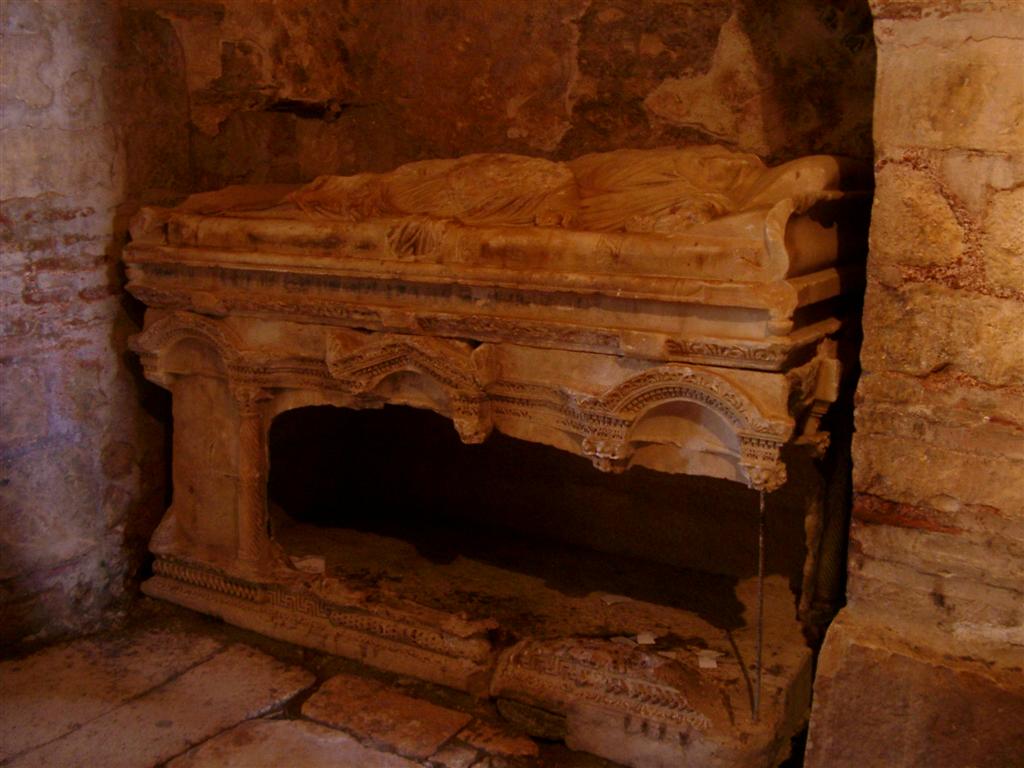
Myra is in modern day Turkey. Wikipedia has this picture of St. Nicholas' original tomb in Myra,


St. Nicholas Day is rarely celebrated in the Episcopal church, but there is a traditional prayer for the day one can find on the lectionary pages,
Almighty God, who in thy love didst give to thy servant Nicholas of Myra a perpetual name for deeds of kindness on land and sea: Grant, we pray thee, that thy Church may never cease to work for the happiness of children, the safety of sailors, the relief of the poor, and the help of those tossed by tempests of doubt or grief; through Jesus Christ our Lord, who liveth and reigneth with thee and the Holy Spirit, one God, for ever and ever.
For more details, go to the Churchmouse's site. As for me, I will put our St. Nicholas ornament on the tree today.


Wednesday, December 02, 2015

New Zealand Church, Like The Episcopal Church is Dropping Like A Stone

Bosco Peters is an Anglican priest in New Zealand, and while I do not agree with his take on most church controversies, I did appreciate the fact that he included his diocese's statistics in a recent blog post.

Here are some of his numbers,

Receiving Communion at Christmas
Year       Received Communion
1990       19,784
2000       15,492
2010       13,411
2014       10,542
Total Church Attendance
Year                               Total Church Attendance
1990 (Sundays only)     472,025
1996 (Every Day)            584,703
2000                                  560,901
2010                                  451,889
2014                                  356,290
My only knowledge of New Zealand comes from a limited exposure to their prayer book during a service foisted upon me by a priest-to-be of the Episcopal Diocese of Upper South Carolina, and another NZ Prayer Book service at a picnic service by our former curate, and Bosco Peter's blog. My first impression is that the church in New Zealand's decline may be due to the same revisionist thinking that infects the Episcopal church in the U.S.A.

"Progressives" in the Church are currently those pushing for prayer book and hymnal revision, same sex marriage rites, gender neutral language, communion of the unbaptized, and what ever else tickles their fancy. This sounds like the same path that the Episcopal church and the Church in New Zealand have tried in the past. The results of going down that road are reflected in the declining numbers of Sunday worshipers and the tiny fraction of members who are involved in prayer groups and Bible study groups. I guess the current crop of church leaders are hoping for a different result this time (most of us would call that the definition of insanity). CS Lewis in The Case for Christianity had something to say about such "progressive" thinking,

“We all want progress. But progress means getting nearer to the place where you want to be. And if you have taken a wrong turning then to go forward does not get you any nearer. If you are on the wrong road progress means doing an about-turn and walking back to the right road and in that case the man who turns back soonest is the most progressive man. There is nothing progressive about being pig-headed and refusing to admit a mistake. And I think if you look at the present state of the world it's pretty plain that humanity has been making some big mistake. We're on the wrong road. And if that is so we must go back. Going back is the quickest way on” ― C.S. Lewis

How far down the wrong road does one have to go before realizing that one has made a mistake?

Sunday, November 29, 2015

For the Episcopal Diocese of Upper South Carolina, this Advent Brings Captivity

This the first Sunday of Advent, and for members of the Episcopal Diocese of Upper South Carolina their Bishop, Andrew Waldo, has declared that Advent 1 will announce the coming of blessings of same-sex marriage in several of the churches under his jurisdiction. At last count, only six or seven parishes had completed the required curriculum to perform these rites, and the question for the rest is not whether or not this represents the coming of a new religious freedom that is to be tolerated and accepted, but whether or not this represents a new religious restriction on traditional practices regarding marriage. 

It is not hard to imagine that the few remaining traditionalist rectors and their flocks in Upper South Carolina may be marginalized, excluded from positions of leadership, exiled, and held for ransom until they submit to the Bishop's new teaching on human sexuality. Rector search committees will be encouraged to seek a "Priest in Charge," a process which produces candidates that have been carefully vetted by the diocese prior to being included in any list given to parishes in need of a priest.

Given this new Advent, will any priest who believes in traditional marriage even be interested in coming to Upper South Carolina?

What is there to look forward to?

Never before have the words of "Ve­ni, ve­ni Eman­u­el" meant so much to pewsitters in the Episcopal Diocese of Upper South Carolina.

O come, O come, Emmanuel,
And ransom captive Israel,
That mourns in lonely exile here
Until the Son of God appear. 
Refrain:
Rejoice! Rejoice!
Emmanuel shall come to thee, O Israel. 
O come, Thou Wisdom from on high,
Who orderest all things mightily;
To us the path of knowledge show,
And teach us in her ways to go.
(Refrain) 
O come, Thou Rod of Jesse, free
Thine own from Satan’s tyranny;
From depths of hell Thy people save,
And give them victory over the grave.
(Refrain) 
O come, Thou Day-spring, come and cheer
Our spirits by Thine advent here;
Disperse the gloomy clouds of night,
And death’s dark shadows put to flight.
(Refrain) 
O come, Thou Key of David, come,
And open wide our heavenly home;
Make safe the way that leads on high,
And close the path to misery.
(Refrain)
O come, O come, great Lord of might,
Who to Thy tribes on Sinai’s height
In ancient times once gave the law
In cloud and majesty and awe.
(Refrain) 
O come, Thou Root of Jesse’s tree,
An ensign of Thy people be;
Before Thee rulers silent fall;
All peoples on Thy mercy call.
(Refrain) 
O come, Desire of nations, bind
In one the hearts of all mankind;
Bid Thou our sad divisions cease,
And be Thyself our King of Peace.
(Refrain)

Wednesday, November 25, 2015

Guess Which Denomination Has The Lowest Level of "Highly Involved" Members

According to the Pew Research center the Episcopal church at 13% has the lowest percentage of highly involved members of all the mainline denominations. The Anglican church did a little better at 26% while the Presbyterian Church USA scored 31%.

"Evangelical" churches fared better with the Southern Baptists hitting 44% and presidential candidate Dr. Ben Carson's Seventh Day Adventist's scored an amazing 56%.

Roman Catholics only hit 16% looking very much like the Episcopal church in this analysis.

One might think that the good news is that most people in the low hanging churches are at least moderately involved, but...
Pew explains that this is “in part because while many of their members attend religious services, they do not participate in a prayer or Scripture group on a weekly or monthly basis.”
Unfortunately for most Anglicans and Episcopalians, it appears that they are punching the time clock on Sunday and doing little else in the way of prayer and Bible study. As detailed here on numerous occasions, this means that their exposure to the Bible is extremely limited and all too often consists of the watered down version of the truth provided by a Sunday lectionary that either avoids or expurgates most of the difficult passages. Plus, the lectionary cycle commonly used repeats on a three-year cycle so that pewsitters wind up hearing a limited set of Bible stories and often hear the same sermon every three years. With so much of the Bible going unread, this must have long lasting effects on such things as the ability to spread the Gospel message and to make moral judgments based on solid theology. This no doubt explains in part the numerical and moral decline of the Episcopal church.

What would the Episcopal church become if a greater percentage of its members became more involved in Bible study, evangelism, prayer, and worship? The current progressive bishops and priests who make up the majority of clergy in TEc would be in trouble. Imagine masses of previously uninformed pewsitters waking up to the falsehoods being foisted on them. A lot of Episcopal clerics would be filing for unemployment.

Those priests and clergy have something to be thankful for this year because it ain't gonna happen anytime soon.

Sunday, November 22, 2015

All the Tribes of the Earth Will Wail

Today's reading from Revelation 1:4-8 contained the line in the title to this post. "Wail" has also been interpreted as "mourn" as wailing is a form of mourning in many cultures.

John to the seven churches that are in Asia:
Grace to you and peace from him who is and who was and who is to come, and from the seven spirits who are before his throne, and from Jesus Christ, the faithful witness, the firstborn of the dead, and the ruler of the kings of the earth.
To him who loves us and freed us from our sins by his blood, and made us to be a kingdom, priests serving his God and Father, to him be glory and dominion for ever and ever. Amen. 
 
Look! He is coming with the clouds;
   every eye will see him,
even those who pierced him;
   and on his account all the tribes of the earth will wail.
So it is to be. Amen.
I am the Alpha and the Omega’, says the Lord God, who is and who was and who is to come, the Almighty. 
All the tribes of the earth will wail/mourn/beat their breasts because there is no tribe that is so righteous that it has nothing to fear. I wonder how many sermons glossed over this point.

Gill's Exposition explains it this way,

"And all kindreds of the earth shall wail because of him; all the wicked, in the several parts of the world, will lament, and wring their hands, and express the inward terror and horror of their minds, at his appearing; they will fear his resentment of all their wicked words and actions; will dread his wrath, and tremble at his righteous judgment:
even so, Amen, says John, and so say all true believers; what the wicked lament, they rejoice at; they desire the coming of Christ, they love it, look and long for it; they believe it shall be, and wish it may be quickly, as in Revelation 22:20; And all kindreds of the earth shall wail because of him; all the wicked, in the several parts of the world, will lament, and wring their hands, and express the inward terror and horror of their minds, at his appearing; they will fear his resentment of all their wicked words and actions; will dread his wrath, and tremble at his righteous judgment:" 

John Gill (1697 – 1771) preached in the same church as C. H. Spurgeon over one hundred years earlier, Wikipedia notes that he
"...was an English Baptist pastor, biblical scholar, and theologian who held to a firm Calvinistic soteriology."
That Calvin reference will probably make some readers immediately dismiss Gill's point because too many assume that it is the other guy or the member of the tribe or church down the street who is the wicked one.

Lord forgive us when we wail.