Showing posts with label Advent. Show all posts

Sunday, December 19, 2010

Looking Forward to the Festival

On this the last Sunday in Advent, we sang our final refrain of "Saviour of the Nations Come" as we looked forward to the anniversary of our Saviour's birth. How we came to celebrate Christmas on December 25 is another story, but one I have heard is that ancient pagan festivals were conquered by Christ and given new meaning by men. All this so that we might be brought to celebrate His life instead of false idols, sacred poles, and the worship in the high places that so bedeviled our ancestors.

A while back, while researching the obscure details of the statutes of the church of Toul, I had a chance to stumble upon The Burlesque Festivals of the Middle Ages (pp155-158) and found the following that might pertain to this time of the year (excerpted, minor corrections made, and highlighting added).

"In the first ages of Christianity, when—a persecuted sect—it trusted to the force of individual conviction for its converts, these latter, in joining the religion of the Saviour, gave up at once all their old superstitions and prejudices. But when, in course of time, it became established as the religion of the state, the mass of the people soon disbelieved in the power of their old gods, and accepted the faith of the emperor. Churches took the place of temples, and the statues of their idols were thrown down and broken without much repugnance. But there was a host of old superstitions, customs, and observances, intimately connected with the old idolatry of the people, which were so deeply rooted in their habits and social life, that it was not an easy thing to persuade converts made under such circumstances to consent to their abolition. In fact, the Christian teachers found an advantage in chewing forbearance in the great religious revolution in which they were engaged, and they were wise in not shocking by a too abrupt change the deeply rooted prejudices of so many ages. It was their policy to substitute gradually Christian festivals in the place of pagan ceremonies ; and thus, amid the most riotous feasts and processions of the ancient ceremonial, new names and new objects kept the popular mind fixed to a better faith. In course of time, however, as the church itself became corrupt and its ministers venal, these popular excesses, which had at first been tolerated from necessity, were encouraged by the very persons whose duty it was to discountenance them ; and, during the middle ages, at certain periods of the year, even the holiest places became the scene of riotous festivals, which recalled in many of their characteristics the most licentious of the feasts of antiquity. It is true that these pseudo-Christian ceremonies were condemned by the better and wiser of the ecclesiastics, and that they were repeatedly proscribed by the councils of the church ; but these condemnations were either merely formal, or they were rendered ineffectual by the supineness and backwardness of those who ought to have put them in force. Too congenial with the general laxity of manners which characterised the feudal period, these ceremonies increased in force and intensity during the fourteenth and fifteenth centuries, until they became so great an object of public scandal that they could no longer be tolerated. Yet in Catholic countries, such as France, and Italy, and Spain, they continued to be observed in a suppressed form until the great dislocation of society produced by the French revolution at the close of the eighteenth century.

Among the Romans the latter part of the month of December was devoted to the noisy and licentious festivities of the Saturnalia. In the earliest times of Rome this festival had been restricted to one day in the middle of the month ; but the period of celebration was afterwards extended to seven days, and it was followed by a multitude of other festivals of the same character, called, from the circumstance of their commencing in the Calends of January, the feriae Kalendarum, which were continued during the month of January, and were but just closed at the time of the somewhat analogous festival of the Lupercals in February. This answers precisely to the period extending from the festivities of Christmas to the time of the carnival of modern times, of which the Roman festivities were undoubtedly the prototype. The resemblance between the old and the modern observances is too strongly marked to be easily mistaken. During the seven days of the Saturnalia masters were placed on an equality with their slaves, and all classes and ranks and even sexes were confounded together by disguises and masks, under cover of which were enacted a thousand different follies and extravagances. These were precisely the characteristics of the joyous festivals of the middle age. A curious coincidence is perhaps worth pointing out. It is well known that at the Lupercalia the Luptrcals ran about the streets in a state of nudity : a similar practice characterised the Saturnalia...

A theological writer who lived in 1182, Beleth, informs us that, in his time, in the archbishopric of Rheims and in other dioceses in France, at the festival of Christmas the archbishops and bishops and other high ecclesiastics went to play at various games with the inferior clergy in the religious houses. We trace this custom among the clergy, called by Beleth Decembrian liberty, in other writers. In the Saturnalia a mock king was elected by lot, who ruled at the festival. The practice of choosing mock officers, under the names in different places of kings, popes, abbots, was retained in all the burlesque festivals of the middle ages : in some parts a king is still chosen on the twelfth night. Public gambling was allowed at the Saturnalia. It is probable from the extract from Beleth that it was practised even by ecclesiastics at Christmas in former days, and from this custom we seem to have derived that of playing at cards at that period of the year. It is not necessary to point out the libertinism of speech and action which characterised the old as well as the modern Saturnalia.

These latter were chiefly prevalent in the countries which have derived their language and customs from the Romans, such as the French, Italians, and Spaniards, and are not found to have prevailed so generally among the purer Germanic tribes. The English festival of Christmas is of Saxon origin, and consisted chiefly in eating and drinking ; the mummery and masquerading, as well as the few burlesque festivals we shall have to notice as belonging to England in the middle ages, having been apparently imported from France. "
This year, I hope to not get so caught up in the modern versions of these festivities that I lose sight of the gift we should stay focused on this season: the gift of His incarnation, and His promise of our salvation.

Share the perfect gift this Christmas...

Only a few days left to find it...

Try it on for size yourself...

It will only cost you...

Everything.

Sunday, December 12, 2010

In the End, It was not a Monster

For her sermon today, Mary Cat related the Advent season to reading a familiar story, one in which you know the ending, over and and over again. The book she chose to use as an illustration was one of her favorites, "The Monster at the End of This Book."


Not being familiar with the story, my mind drifted to the first time I heard one of my favorites, "The Lion, the Witch, and the Wardrobe." It was in fourth grade, and Mr. Andre, the Physical Education teacher/Assistant to the Assitant Headmaster/Assistant for Religious Education/and Assistant to Fill In Anywhere Else, a man I never trusted very much, chose this C.S. Lewis classic our listening benefit. At first we all thought we were a bit too old to be read to, but I came to look forward to this weekly break in our routine. For a youngster who was too young to recognize the religious themes, the monster near the end of this book had to be the death of Aslan at the hands of the witch. So, when we ended one week's reading at that horrible point, this young mind was left wondering, "Why did he have to die?" Pondering this over a long weekend, the tragedy felt all the greater, and is forever etched in my memory. I also remember the mixture of confusion, pleasure, and relief at Aslan's return when the story concluded with Mr. Andre's next reading.

I clearly remember Mr. Andre questioning us and instructing us on the meaning of Aslan's sacrifice. The "monster" was explained and was no longer to be feared.

Reading the Lion the Witch and the Wardrobe again and again always seems to bring some new insight. I have the entire series in audio format which I have been through twice. Last night, the cinematic version aired on network TV. I watched the whole thing, enjoyed every minute, and was moved in ways I had not been moved before. I wonder how first-timers felt? Can film ever take the place of the experience of the written word?

Most of us have been through more Advents than Narnias, but despite knowing the back of the book, much can be gained by being open to hearing previously missed undertones, rejoicing at the new insights, and listening for the voice of calm of the author as He tells his familiar story again, and again, and again.


Sunday, December 05, 2010

Advent Pageant: Lessons Missed

Today's service at ECOOS was a departure from our tradition in that the children of the parish put on an "Advent Pageant." This required some imagination on the part of both the creator, the music director, and the observer to keep us in the spirit of Advent without slipping into Christmas. While the children did a great job with what they were given, and the congregation was pleased with the results, I have to note the omissions that were made to the service because I am left with the feeling that something was missing.

The Psalm was one of the first things to go.  Todays' Psalm was going to be an expurgated version of Psalm 72, so I shouldn't complain too much. According to the lectionary, we should have heard Psalm 72:1-7, 18-19 ,
1 Give the king your justice, O God, and your righteousness to a king’s son.

2 May he judge your people with righteousness, and your poor with justice.

3 May the mountains yield prosperity for the people, and the hills, in righteousness.

4 May he defend the cause of the poor of the people, give deliverance to the needy, and crush the oppressor.

5 May he live while the sun endures, and as long as the moon, throughout all generations.

6 May he be like rain that falls on the mown grass, like showers that water the earth.

7 In his days may righteousness flourish and peace abound, until the moon is no more.

18 Blessed be the Lord, the God of Israel, who alone does wondrous things.

19 Blessed be his glorious name for ever; may his glory fill the whole earth.Amen and Amen. 

Nice, but incomplete. Here are the missing verses including, as expected, an imprecatory one,
8 May he have dominion from sea to sea, and from the River to the ends of the earth.

9 May his foes bow down before him, and his enemies lick the dust.

10 May the kings of Tarshish and of the isles render him tribute, may the kings of Sheba and Seba bring gifts.

11 May all kings fall down before him, all nations give him service.

12 For he delivers the needy when they call, the poor and those who have no helper.

13 He has pity on the weak and the needy, and saves the lives of the needy.

14 From oppression and violence he redeems their life; and precious is their blood in his sight.

15 Long may he live! May gold of Sheba be given to him. May prayer be made for him continually, and blessings invoked for him all day long.

16 May there be abundance of grain in the land; may it wave on the tops of the mountains; may its fruit be like Lebanon; and may people blossom in the cities like the grass of the field.
Ah well, sacrifices must be made, but wait, there was another cut made in the reading from Isaiah 11:1-10 which was printed in the bulletin sans verses 3-4, 5.5, and 7-9. Here is how it came out as edited,
1 A shoot shall come out from the stock of Jesse,
and a branch shall grow out of his roots.
2 The spirit of the Lord shall rest on him,
the spirit of wisdom and understanding,
the spirit of counsel and might,
the spirit of knowledge and the fear of the Lord.
5 Righteousness shall be the belt around his waist...
6 The wolf shall live with the lamb,
the leopard shall lie down with the kid,
the calf and the lion and the fatling together,
and a little child shall lead them.
10 On that day the root of Jesse shall stand as a signal to the peoples; the nations shall inquire of him, and his dwelling shall be glorious.
That sounds sweet. I am so glad the children were protected from some of the harsher language. Since most readers of these pages are older, I present the missing verses here,
3 His delight shall be in the fear of the Lord.
He shall not judge by what his eyes see,
or decide by what his ears hear;
4 but with righteousness he shall judge the poor,
and decide with equity for the meek of the earth;
he shall strike the earth with the rod of his mouth,
and with the breath of his lips he shall kill the wicked.

5.5 and faithfulness the belt around his loins.

7 The cow and the bear shall graze,
their young shall lie down together;
and the lion shall eat straw like the ox.
8 The nursing child shall play over the hole of the asp,
and the weaned child shall put its hand on the adder’s den.
9 They will not hurt or destroy
on all my holy mountain;
for the earth will be full of the knowledge of the Lord
as the waters cover the sea.
Good thing they left out verse 8 or we might have heard another Freudian slip, but what is wrong with having the kiddos learn a little bit about the fear of the Lord and what happens to the wicked?

Alas, poor Paul, Romans 15:4-13 got cut altogether.
4 For whatever was written in former days was written for our instruction, so that by steadfastness and by the encouragement of the scriptures we might have hope. 5 May the God of steadfastness and encouragement grant you to live in harmony with one another, in accordance with Christ Jesus, 6 so that together you may with one voice glorify the God and Father of our Lord Jesus Christ.
7 Welcome one another, therefore, just as Christ has welcomed you, for the glory of God. 8 For I tell you that Christ has become a servant of the circumcised on behalf of the truth of God in order that he might confirm the promises given to the patriarchs, 9 and in order that the Gentiles might glorify God for his mercy. As it is written,
‘Therefore I will confess you among the Gentiles,
and sing praises to your name’;
10 and again he says,
‘Rejoice, O Gentiles, with his people’;
11 and again,
‘Praise the Lord, all you Gentiles,
and let all the peoples praise him’;
12 and again Isaiah says,
‘The root of Jesse shall come,
the one who rises to rule the Gentiles;
in him the Gentiles shall hope.’
13 May the God of hope fill you with all joy and peace in believing, so that you may abound in hope by the power of the Holy Spirit.
I am sure we could have editted out that mention of circumcison in v.8.

Gone also was the entire Nicene Creed as well as the Confession of Sins.

I didn't hear any complaints, but IMHO those are so very important that their omission must be noted.

Thankfully, I had a private confession with the Lord before the service, but I always worry about coming to the Lord's table unrepentant.

Apart from that and getting doses of "Hark the Herald Angels Sing," and "Go Tell it on the Mountain" a few weeks earlier than expected, I should be thankful for the two blessings of today: no sermon, and the service was over in an hour.

Did I miss anything?

Sunday, December 07, 2008

Advent 1941 or Wake Up and Smell the Altar Flowers


After last week's readings making us mindful to be awake for the coming of the Lord, and this week's emphasis on preparing the way of the Lord, I had to reflect on the second week in Advent, 1941. As I dozed off during Mary Cat's sermon, I thought I could smell the altar flowers given today to the glory of God and in loving memory of Admiral Husband E. Kimmel and his sons Captain Thomas Kinkaid Kimmel, LCDR Manning M. Kimmel, and LCDR Edward R. Kimmel and in honor of all those in the military who have served their country and protected its freedoms, by Manning and Sheila Kimmel.

Yes, today is December 7, Pearl Harbor day. A day which is fading from our nation's collective memory. A morning when our armed forces were caught less than awake for the rising of an Imperial sun.


I read an interesting book, "At Dawn we Slept" by Gordon Prange et al (McGraw-Hill 1981)which dissects the events leading up to and following the attack including the Congressional hearings and the verdicts of history. Anyone studying the 9/11 Commission report would be wise to read this book and understand that there is usually more to any story, and that it sometimes takes years to piece things together. Our parishioner Manning Kimmel, who has helped lead the fight for the late Admiral Kimmel, has seen first hand the difficulty in getting people to wake up. The lessons of Pearl Harbor were forgotten by the time 9/11 rolled around. Perhaps the next book we read will be "And We Continue to Sleep."

This week I watched another parishioner, Phil Glennon on CN2's "THE CITY MINUTE" with Betty Jo Rhea. He gave a great reflection on his time as a submariner in the Pacific in WWII. If you see him, thank him for his service, and remember the submariners who did not return home.

Will the lessons of Advent be forgotten as well? What are we doing on a daily basis to be prepared for the day of the Lord? What will that morning be like? Will it be all Christmas presents and baby Jesus?

Such preparation is hard work. We are to stay awake and make straight the way of the Lord. All are to be encouraged in their labors on this highway project. But if the surveyors and planners start reading the plans wrong, or if they choose to ignore history and other sources of intelligence, what kind of path will the laborers take? I am worried that the leadership of the Episcopal Church has veered off the straight and narrow path which we are called to prepare. As the numbers presented in the last post demonstrate, the workers are losing confidence in their leaders. Will these leaders ever wake up, or will they "continue to sleep?"

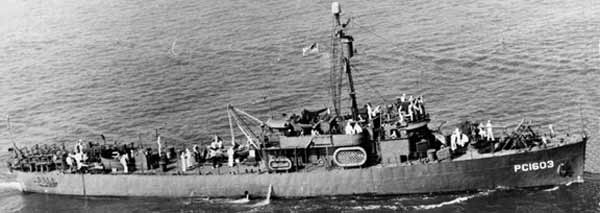
Oh yes, Wallace Hartley pointed out that "Advent" is ironically the name of a sub chaser from WWII.
He could not find a photo of the USS Advent (Laid down 08/18/1941, commissioned 1942), but provided a picture of the Force, PC 1603, it was in the same class as the Advent PC 1587