Showing posts with label Staying. Show all posts

Wednesday, May 19, 2010

Pewsters in the Stocks


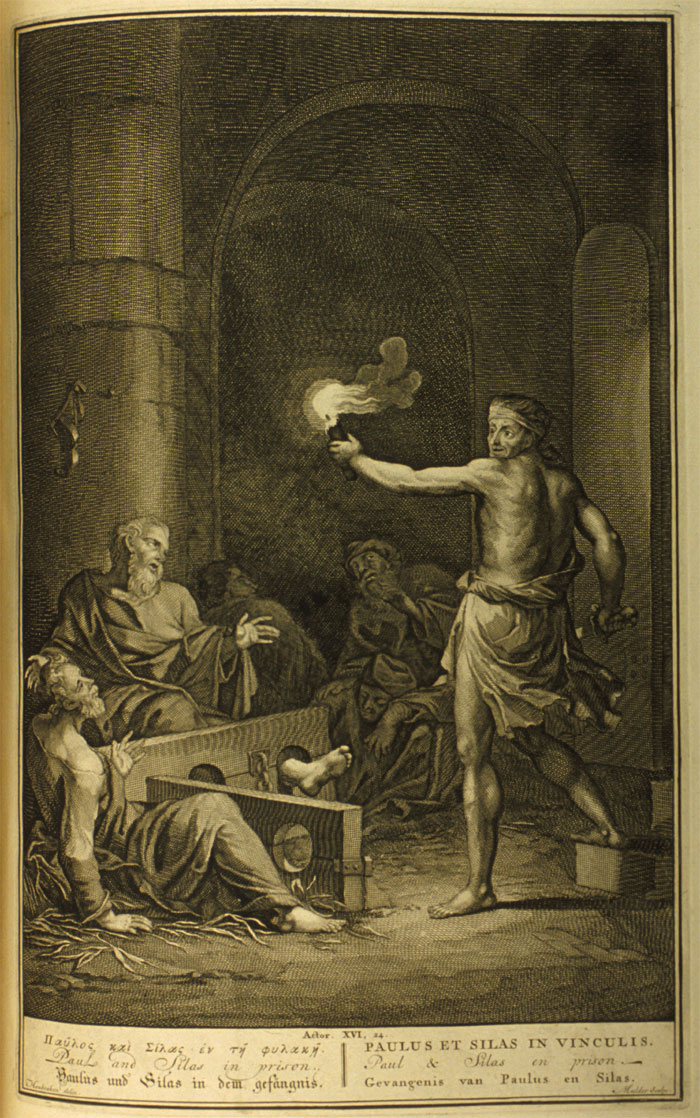
Figures de la Bible. Illustrated by Gerard Hoet, and others.
Published by P. de Hondt in The Hague (La Haye). 1728. Image courtesy History of Science Collections, University of Oklahoma Libraries

This past Sunday, we had part II of our "Instructed Eucharist." The interruptions this created in the flow of worship were so annoying to several other confidants that they related to me their relief that this experiment would probably not be replayed anytime soon. I found the interruptions had a negative effect on my worship in that I noticed a greater separation from God during the service. That feeling of separation was so profound that I could not blog about it properly until today.

In this Sunday's sermon (the 10:30 a.m. version), our rector avoided repeating his 8:00 a.m. error of injecting the politics of inclusion (read Arizona's immigration laws)into the homily, and instead focused on the reading from Acts 16:16-34.

Paul's motivation for ordering the demon out of the annoying prophetic slave girl was, according to this sermon, an act of love, motivated by pity from seeing the poor girl afflicted by a demon. I didn't hear it that way. Let's go back to the text,
One day, as we were going to the place of prayer, we met a slave-girl who had a spirit of divination and brought her owners a great deal of money by fortune-telling. While she followed Paul and us, she would cry out, ‘These men are slaves of the Most High God, who proclaim to you a way of salvation.’ She kept doing this for many days. But Paul, very much annoyed, turned and said to the spirit, ‘I order you in the name of Jesus Christ to come out of her.’ And it came out that very hour.

Paul's motivations are clearly stated, he was annoyed, otherwise this would have been a routine exorcism carried out in his first encounter with the girl. If this was primarily an act of love for the slave girl, wouldn't that have been documented? No, instead we hear that Paul was not just "annoyed," not just "very annoyed," but "very much annoyed." Any other motivations are purely speculative. After this imaginative start to the sermon, I could never get quite back on track and remained distracted. This distraction worsened as the "Instructed Eucharist" stumbled forward.

I did not get much out of the superficial "instructions" that interrupted the normal flow of the liturgy. I felt that this type of thing would be better done in a small group educational setting such as Sunday school, but shackled to my pew, I soldiered on.

My mind wandered to Paul and Silas as prisoners, their feet in stocks, singing hymns:

After they had given them a severe flogging, they threw them into prison and ordered the jailer to keep them securely. Following these instructions, he put them in the innermost cell and fastened their feet in the stocks. About midnight Paul and Silas were praying and singing hymns to God, and the prisoners were listening to them.

Note that they spent the night singing to God and not bemoaning their imprisonment. The next part of the reading from Acts really distracted me because it raised echoes of the earth shaking changes the Episcopal church has been bringing upon us:
Suddenly there was an earthquake, so violent that the foundations of the prison were shaken; and immediately all the doors were opened and everyone’s chains were unfastened. When the jailer woke up and saw the prison doors wide open, he drew his sword and was about to kill himself, since he supposed that the prisoners had escaped. But Paul shouted in a loud voice, ‘Do not harm yourself, for we are all here.’

This hit home not just because I was silently hoping the earth would shake and the Instructed Eucharist would end, but because I also saw an analogy with the remaining orthodox, those who did not flee to safety following the consecration of Gene Robinson in 2003 or following the consecration of Mary Glasspool on Mat 15. 2010. Flogged, put in stocks, and locked away, we have been offered a chance to flee to the new Anglican Church in North America or to other denominations (I greatly appreciate R. Sherman's offer of sanctuary in Missouri). Do we stay in prison out of ignorance, or is it for the love of God? Do we win converts by grumbling or crying out, or should we try to follow Paul and Silas' example by staying and making a joyful noise unto the Lord? What should we do when an opportunity for freedom suddenly appears? Is the Anglican schism like Paul's earthquake?

Other analogies kept popping up. The jailer's first impulse was to think that if the prisoners escaped, then he himself was doomed. This brings to mind the numerous lawsuits being pursued by the Episcopal church over departing parishes and dioceses. It is as though the Presiding bishop and her attorneys have adopted the role of jailer, and through her possession of the keys to church buildings she will discourage the prisoners from attempting a mass breakout. The desperate legal actions and maneuverings of the P.B. suggest, like the jailer, that there is an underlying fear of the consequences to herself if there are any further defections from T.E.C.

Paul's example also has me rethinking what I had considered to be a doomed "stayer" policy. The idea that the Episcopal church can be converted en-masse is ridiculous of course, but the power of faith that Paul and Silas displayed, a power that freed the jailer himself, is the kind of power that today might have effects beyond those that could ever be imagined by this distracted, grumbling blogger.

When freedom calls, perhaps we need to sit still, take stock, and praise God for his Word for that is who truly sets us free. With Him, we are free from fear of distraction and separation from God, and free from the finality of death. By not fleeing, but staying, unwavering in our hymns, oh, what a witness we could be.

Wednesday, July 22, 2009

A Leonidas Moment?

Earlier this week I chanced to look down at the detritus left from recent house cleaning and yard sale material preparation and saw a little book alone on the floor that had somehow freed itself from the clutches of the ravagers and pillagers of my beloved treasures. While their backs were turned, I snatched it up and retreated to my cave. Some of you might recognize this book, The Will of God by Leslie Weatherhead first printed in 1944. In it, a series of sermons takes a look at God's will, and the concept is broken down into God's intentional will, circumstantial will, and ultimate will. I felt the book was asking for a re-read, so that's what I did. In a way, this helped me "decompress" after the recent General Convention of the Episcopal church. So many people are asking so many questions, that I had to stop and think, "Where is God in all this?"

My take on the ultimate will of God is that it is sometimes too difficult to accept, or we are so blinded by ourselves and the world, that we can never see God's ultimate will on our own. We are too impatient or self indulged to humble ourselves to Him as we busily try to plan our day or our futures as if He did not exist. The author uses what I would consider a strong classical argument that God's circumstantial will is intimately involved with the problems of Evil, Sin, and pain, those worldly things that try to steer us from God's intentional will. Regular readers of this blog may remember that Evil and Sin are not popular subjects at our parish, and from the reports from GC 09, not terribly popular with the modern Episcopal church in general. The church, by choosing to ignore the subjects, give Evil and Sin the perfect opportunity to work their way into the Church, thus setting up the current circumstances with which so many are struggling. Was this God's intention? Did God, through His intentional will, endorse D025 and C056? Did God will the rejection of D069*, or are these the actions of humans and their free will? Here we are, face to face with the circumstantial will of God. How we respond to these circumstances should be where we place our focus.

I personally find myself in interesting circumstances as a member of this disordered organization. This is nothing new of course. I recall 1979, 2003, 2005, 2006, and now 2009 as times in which the Episcopal church revealed how Evil advances its goals. At no point have I thought that this was the "movement of the Spirit" or "the will of God." It all looked more like the work of fallen man. Let me break it down in an overly simplified method similar to what is discussed in the little book.

1. Intentional Will: It is God's intention that I turn to Him, repent, and love and worship Him as my Lord and Savior.

2. Circumstantial Will: Evil is constantly attacking God's intention, and in this case, His Church, by presenting false doctrines and false prophets to which God's people, by their free will, are easily turned. These are the circumstances man has placed us in and it is where we find ourselves today, pulled away from God's intent.

3. Ultimate Will: This may not be revealed in my lifetime, but the question for me is how do I act in accordance with #1 to do my part for #3?

Some might flee and find comfort in an orthodox church, others might leave the church altogether (as some of our former congregants at ECOOS have done). This simple pewster agrees that the circumstances are dangerous, but I, for one, have been led to challenging them, and no, I am not expecting to change the world. One thing about this journey is that it is not easy, it requires study, prayer, more study, more prayer, and it cannot be done alone. At some point, even a simple pewster might be tempted to call it quits, to swim the Tiber, or to heed some such call. Why battle the Evil circumstances here that challenge God's intention when there is a safe spot down the street?


Can circumstances ever get so bad that I would leave the Episcopal church?

Clifford at Red Stick Rant appears have reached that point. Read his illustration of the fictional Leonidas restaurant (he named that after Leonidas Polk, the "fighting bishop") losing customers because of changes in the staff, what they were serving, changes in the ownership, and eventually losing Red Stick himself when the place becomes totally unrecognizable. (Click the Red Stick Rant link for the long version).

Nice analogy, but is July 2009 a Leonidas moment?


I don't think so. I think anyone wondering if this is the moment needs to proceed to chapter 4 of Weatherhead's little book. The chapter is entitled "Discerning the Will of God." Go there because the question on many moderate and conservative Episcopalians' minds is "Where do I go from here?" Part of our Christian being calls us to ask for God's help at such times. (As humans, we usually call only during troubled times, but that is a subject for another post.) The chapter ends with two questions:
1. "Do I really want to discern God's will or do I want to get his sanction for my own?"
2. "Have I got the courage to do God's will when I discern it?"

I came up with another,

3. What will happen if I reject God's will?


As I try to discern His will, I see, in all the conflicts of the day, the need to confront Evil. I recognize my limited ability to do so given my past upbringing in this Episcopal church. I accept the challenge to increase my understanding of God's purpose so that I can better defend it.

If I reject His will, walk away from His promise, then His sacrifice was in vain.

* ORIGINAL TEXT of Rejected Resolution: C069 Title: Affirm Christ in multi-faith society
Topic: Evangelism
Committee: 12 - Evangelism
House of Initial Action: Deputies
Proposer: Diocese of Western Louisiana

--------------------------------------------------------------------------------


Resolved, the House of _______ concurring, That this 76th General Convention of this church affirm the conclusion of the Church of England at its February General Synod and direct the House of Bishops' Committee on Theology to report back to the 77th General Convention on "their understanding of the uniqueness of Christ in the United States multi-faith society, and offer examples and commendations of good practice in sharing the gospel of salvation through Christ alone with people of other faiths and of none."


EXPLANATION

Indicative of our support and appreciation for the presence of the Archbishop of Canterbury at this General Convention and his leadership of the Church of England in Christian witness within the multi-faith culture of the United Kingdom, this resolution affirms that the Episcopal Church is in substantial agreement with the Church of England General Synod which directed its House of Bishops at their February 2009 meeting to report back on "their understanding of the uniqueness of Christ in Britain's multi-faith society, and offer examples and commendations of good practice in sharing the gospel of salvation through Christ alone with people of other faiths and of none."

Supporting document "General Synod 2/11/09" is posted and available in hard copy in the General Convention Secretariat until the end of the 76th General Convention.