Showing posts with label Truth. Show all posts

Wednesday, March 26, 2014

The Death of Truth


"Pilate said to Him, 'What is truth?' And when he had said this, he went out again to the Jews, and said to them, 'I find no fault in Him at all.'" John 18:38
Several blog posts recently highlighted the all pervasive notion that there is no "Truth" that anyone can ever hope to grasp, and reminded me that for most people today, "my truth" is just as good as "your truth." One consequence of this philosophy is that its corollary is often assumed to be just as acceptable. When "your truth" is just as good as "my truth", I become subject to following whatever proposition I cannot totally reject out of hand. The error of Pilate, which was to initially find no fault in Jesus but to later accept the crowd's finding of fault as sufficient justification for legal condemnation, might also be explained by this philosophy. While we see some of this same error playing out in legal cases today (the accuracy of eye-witness testimony to the truth is increasingly called into question), the larger problem occurs in the public arena before issues become cases for the courts. For example, our society gets tangled up in all kinds of problems and issues such as same sex marriage in part because people try to pull moral judgments out of the vacuum of moral relativism in which we live. The consequence of that for many bloggers is as Bill Muehlenberg points out,
"If there are no objective moral absolutes, then to make a moral judgment is seen as the height of intolerance and bigotry."
The problem runs deeper than the periodic moral dilemma of the day. It strikes at the core of our belief in God, in Jesus, and in the Apostolic witness. How can modern Christians proclaim the truth of the Gospel to a world that is hostile to the idea of "Absolute Truth"? To the world, "Gospel Truth" = "Intolerance and bigotry," and as such, the deeper meaning of truth must be eliminated from the minds of men.

Turn next to the philosophers who have been doing their best in the war on truth. The following was posted by Kendall Harmon on March 3, 2014 at T19,
If you study any philosophical treatise of our present era you will with almost absolute certainty not encounter the concept, and much less the expression, “the truth of all things.” This is no mere accident. The generally prevailing philosophical thinking of our time has no room at all for this concept; it is, as it were, “not provided for.” It makes sense to speak of truth with regard to thoughts, ideas, statements, opinions—but not with regard to things. Our judgments regarding reality may be true (or false); but to label as “true” reality itself, the “things,” appears to be rather meaningless, mere nonsense. Things are real, not “true”!  
Looking at the historical development of this situation, we find that there is much more to it than the simple fact of a certain concept or expression not being used; we find not merely the “neutral” absence, as it were, of a certain way of thinking. No, the nonuse and absence of the concept, “the truth of all things,” is rather the result of a long process of biased discrimination and suppression or, to use a less aggressive term: of elimination.
--Josef Pieper: An Anthology (San Francisco: Ignatius Press, 1989 E.T. of the 1981 original), pp. 95-96
 
I posted the following comment at T19,
"I guess any meaning one might give to Philippians 4:8 has been 'eliminated'.
'Finally, brethren, whatever things are true, whatever things are noble, whatever things are just, whatever things are pure, whatever things are lovely, whatever things are of good report, if there is any virtue and if there is anything praiseworthy—meditate on these things.'
C.S. Lewis would probably classify the elimination of the concept of "the truth of all things" under what he called 'the death of words.'"
If there is no truth, nothing pure, then nothing is praiseworthy, and there is nothing upon which to meditate.

Let me expand on that comment by quoting Lewis,
"But the most important sense of a word is not always the most useful. What is the good of deepening a word's connotation if you deprive the word of all practicable denotation? Words, as well as women, can be 'killed with kindness'. And when, however reverently, you have killed a word you have also, as far as in you lay, blotted from the human mind the thing that word originally stood for. Men do not long continue to think what they have forgotten to say."

C.S. Lewis, "The Death of Words" From (C.S. Lewis On Stories, Harcourt Brace Jovanovich 1982, p. 107)
And all of this may lead to why mankind appears to not spend much time thinking about this,
"Jesus saith unto him, I am the way, the truth, and the life: no man cometh unto the Father, but by me." John 14:6

Wednesday, February 23, 2011

"Such truths are ‘non-negotiable'"

"What truths?" you ask (unless you are an Episcopalian in which case the question should be, "Who are you to define truth for me?).

This article from 2009 at LifeSiteNews came to mind when I was pondering the different conclusions reached by the Episcopal church and the Catholic Church regarding same sex relationships.
"Long Island’s Bishop William Murphy has come out swinging at Nassau County Executive Thomas Suozzi, after the New York politician publicly stated he was a 'practicing Catholic' who now supports same-sex 'marriage,' a position that Murphy said is incompatible with being Catholic."
But would be perfectly compatible with a practicing Episcopalian.
"Suozzi, the DeCounty Executive for Nassau County, expressed his support for same-sex “marriage” in a June 13 op-ed for the New York Times. Suozzi described himself as a “practicing Catholic,” who had abandoned his previous support for civil unions, saying now anything less than civil same-sex “marriage” would create “a separate and unequal system."
And same sex marriage is somehow equal?
"Bishop Murphy penned a forceful response in that week’s edition of the Long Island Catholic, the newspaper for the Rockville Center diocese, stating he felt compelled to respond publicly to Suozzi, “because [Suozzi] publicly identifies himself as a practicing Catholic.” Murphy stated that Suozzi was “contradicting some basic moral teachings of his own faith” that no Catholics are free to deny.

“The logic of Mr. Suozzi’s argument is difficult to discern,” wrote Murphy. “It seems that he has become convinced that because he has met homosexual persons who have suffered discrimination, they now have a ‘right’ to insist that the state redefine their private sexual relationships and give such the term of marriage.”

Bishop Murphy made clear that Suozzi’s disregard for the Church’s teaching on same-sex “marriage” and “abortion” do not qualify him to be a practicing Catholic, because these teachings are “unambiguous, faithful to the Lord and binding on all Catholics.”

“In saying this, I am not singling out Mr. Suozzi. I am speaking to all Catholics in our diocese and beyond, reminding them that what we bishops teach is not “another opinion” among many that Catholics may choose or not choose.”

“Instead, such truths are ‘non-negotiable,’ binding on all of us who claim to be ‘practicing Catholics,’” reiterated Murphy. “Otherwise we are not faithful to our Lord, to His Church and to the ultimate truths about the human person which alone can bring us freedom, justice, joy and peace.”

I agree that there are ultimate truths about the human person which can bring us freedom, justice, joy, and peace. They can be found in the Bible. As an Episcopalian however, I lack a bishop who can render a statement about human sexuality as anything other than "another opinion." If I have a question, where am I to turn?

Ever since they started printing the Bible for the masses, problems of authoritative interpretation have been multiplying as fast as authors of controversial books. At the present time, some denominations have come to the point where all interpretations are acceptable as long as we can still hug each other during the passing of the peace.

The passing of the peace...requiem aeternam. Yes that is where our freedom can lead us, to the injustice of biblical revisionism, to the misery of the soul made slave to the flesh, to the loss of peace.

Bishop Murphy's solution to issues such as those concerning sexuality is to rely on the teachings of the bishops. The Episcopal protestant way was the way intended in the Articles of Religion,
XX. Of the Authority of the Church.
The Church hath power to decree Rites or Ceremonies, and authority in Controversies of Faith: and yet it is not lawful for the Church to ordain any thing that is contrary to God's Word written, neither may it so expound one place of Scripture, that it be repugnant to another. Wherefore, although the Church be a witness and a keeper of Holy Writ, yet, as it ought not to decree any thing against the same, so besides the same ought it not to enforce any thing to be believed for necessity of Salvation. (1801)
but as evidenced by the actions of recent general conventions and by the actions of the bishops of the church in ordaining whosoever they please and teaching highly individualized new gospels, the Episcopal approach has devolved into a "do as you so desire" non-solution that openly parades its contrariness to God's Word written.

We should learn from the failures of both approaches.

Catholics, follow your bishops, Episcopalians, please open your Bible and turn to...
Romans 1:16-28 (NAB)
"For I am not ashamed of the gospel. It is the power of God for the salvation of everyone who believes: for Jew first, and then Greek.
For in it is revealed the righteousness of God from faith to faith;
as it is written, 'The one who is righteous by faith will live.'
The wrath of God is indeed being revealed from heaven against every impiety and wickedness of those who suppress the truth by their wickedness.
For what can be known about God is evident to them, because God made it evident to them.
Ever since the creation of the world, his invisible attributes of eternal power and divinity have been able to be understood and perceived in what he has made. As a result, they have no excuse; for although they knew God they did not accord him glory as God or give him thanks. Instead, they became vain in their reasoning, and their senseless minds were darkened.
While claiming to be wise, they became fools
and exchanged the glory of the immortal God for the likeness of an image of mortal man or of birds or of four-legged animals or of snakes.
Therefore, God handed them over to impurity through the lusts of their hearts for the mutual degradation of their bodies.
They exchanged the truth of God for a lie and revered and worshiped the creature rather than the creator, who is blessed forever. Amen.
Therefore, God handed them over to degrading passions. Their females exchanged natural relations for unnatural,
and the males likewise gave up natural relations with females and burned with lust for one another. Males did shameful things with males and thus received in their own persons the due penalty for their perversity.

And since they did not see fit to acknowledge God, God handed them over to their undiscerning mind to do what is improper."
P.S. Nassau County Executive Thomas Suozzi lost his re-election bid and conceded defeat on Dec. 1, 2009.

Wednesday, January 05, 2011

Truly, A Trivial Pursuit


This past Christmas, while pursuing some entertainment, I chanced upon "The Bishop's Wife" starring Cary Grant, David Niven, and Loretta Young. While it was for the most part a pleasant diversion, watching the angel Dudley (Cary Grant) get uncomfortably cozy to the Bishop's wife (Loretta Young) got a bit creepy to me (and to the Bishop as well). At the current pace, the title "The Bishop's Wife" will undoubtedly take on a whole new meaning in the not too distant future (as far as the Epsicopal church is concerned)...

At the end of the movie version, David Niven, who plays the preoccupied and suspicious Bishop, is reading the sermon that Dudley had substituted for the Bishop's original script. The careful viewer might notice that to the Bishop's left as he stands in the pulpit is a hymn board with three hymns posted for that Christmas. Knowing that the good film director placed that hymn board there for a reason, and selected those hymns for a reason, left me wondering...

What were they?


Answers below.


12

382

268

Next question: Name the Hymn or cite the first verse...

(Insert theme from "Final Jeopardy")


Did I forget to mention that you needed to pull out your 1940 Hymnal?

If you can't find yours, here is a link to an on-line version.

If you don't want to go there, here are the answers:

12 O come, all ye faithful

382 O where are kings and empires now

268 I bind unto myself today


#382 is one we don't sing anymore because it got left out of the 1982 Hymnal.

I can't imagine why...

O where are kings and empires now
of old, that went and came?
but Lord, thy Church is praying yet,
a thousand years the same.

We mark her goodly battlements
and her foundations strong;
we hear, within, the solemn voice
of her unending song.

For not like kingdoms of the world
thy holy Church, O God,
though earthquake shocks are threatening her,
and tempests are abroad.

Unshaken as eternal hills,
immovable she stands,
a mountain that shall fill the earth,
a house not made by hands.


--------------------------------------------------------------------------------
Words: Arthur Cleveland Coxe, 1839

Since the Bishop in the film was preoccupied with fundraising for the construction of a cathedral, the last line of the hymn might be the reason why the director chose that particular hymn.

I wonder why "O where are kings and empires now" got left on the cutting room floor during the 1982 revision of the hymnal?

I can only guess that the references to "earthquake shocks" that "are threatening her," and "tempests are abroad" struck too close to home. Or maybe "the solemn voice of her unending song" was not thought to be clappy happy enough to reach the current generation. Or perhaps the idea of "goodly battlements" was an image the post-Vietnam era wished to reject because it sounded too militaristic.

Maybe they thought new hymns would be a better box office draw. (Oops!)

Or maybe they thought that hands could build a proper house. (In which case they didn't watch the movie).

I have a hard time understanding the workings of the inner circles that decide these things, but every few decades we get a new Hymnal, a new Prayer Book, but why?

In pursuit of truth, the wise follow the money.

Maybe the earthly desire of the Clergy Pension Fund, which profits from the sales of new hymnals and prayer books, is the impetus behind the need for revisions.

The film instructs us that the pursuit of money to the neglect of our loved ones is not always wise.

In pursuit of "The Bishop's Wife" the wise tune to TCM on Jan 6, 2011 at 3:00 pm.

Wednesday, December 08, 2010

It Is Not That We Grow More Conservative...

...it is that the Church grows more liberal.

A copy of a recent short article by Tim Funk in the Charlotte Observer was thrust into my pocket the other day at coffee hour. I did not see the hand behind the missive, but after taking the clipping back to my underground lab and having it analyzed, I think I can identify the tell tale imprint of that old denizen of the dark, Deep Pew.

The story is about the retirement of the Rev. William Wood from First Presbyterian Church in Charlotte after 27 years as their pastor. During that time the church grew from 1200 members to 2200, "revenues" have gone from $600,000 to 6 million dollars, with this all occurring during a period of decline in the Presbyterian Church that parallels the decline in T.E.c. and other "mainline" denominations.

So what made First Pres. in Charlotte different?

Could it have been the preaching?
"William Rikard, a lawyer who served on the search committee that brought Wood to First Presbyterian, said he's (Wood) lived up to his early promise."

"'We saw a young minister who was full of energy and a willingness to preach with force and vigor,' Rikard said. 'He started that way and he has finished that way.'"

Or was it because Wood did not yield to the pressures of the modern age?
"Wood has his critics. Some have not forgotten that, though he welcomes gays and lesbians into the church, he voted in the 1990s to keep the ban on non-celibate homosexuals as clergy in churches affiliated with the Presbyterian Church (USA)."

Or was it his stance against secularism?
"At Davidson, first as a board member and later as an ex-board member, he fought a proposal that eventually allowed the election of non-Christians to the governing body at the school founded by Presbyterians."

Oh, you say, he sounds like a preacher who has grown too conservative over time. To that Wood answers,
"A lot of the leaders in the Presbyterian church have become so liberal," he said. "I have stayed in the same place."

We in T.E.c. often say the same thing, that the church's leftward drift makes us look more and more curmudgeonly with the passing years while in reality we haven't changed. Tensions occur when the left pulls so hard against the Bible (which does not move) that the people in the pews become confused and begin to wander. Such tensions require the strong arms of a preacher who teaches the simple truths to be found in the Bible to rein in his flock and to gather in the lost, especially during this time of increasing secularism, worldliness, and religious pluralism.

Having witnessed first hand the inevitable decline that occurs when the Word of God gets stripped of its power by being preached as the word of man, I am left to wonder if the mainline denominations, apart from a handful of stalwarts like the Rev. Wood, have sown the seeds of not only their own destruction, but also the destruction of the birds who happen to build their nests in those swaying branches of Christendom that do not root themselves on the solid rock that is the witness to our salvation.


Vic Van Den Bergh heard a question/statement this past week that he posted as I was finishing up this piece. It is as applicable to any denomination as it is to the CoE.
"Why don't those people who are the leaders of our denomination keep to God's Word and why don't they help (and protect) us ordinary people from having a line that just keeps on moving! Surely," they said, "What we believe must be constant and so those in leadership should be helping us maintain our consistency, not keep changing that which we believe to accomodate others or make us acceptable to others!"

Instead of redrawing increasingly vague, wavy lines, I was reminded what leaders are supposed to do and say,
"We shall defend our island, whatever the cost may be, we shall fight on the beaches, we shall fight on the landing grounds, we shall fight in the fields and in the streets, we shall fight in the hills; we shall never surrender."
Winston Churchill
Never surrender, and just maybe the invasion of universalisecular-pluralism can be stopped, and guess what might happen then????

Wednesday, August 26, 2009

Summer Reading Report


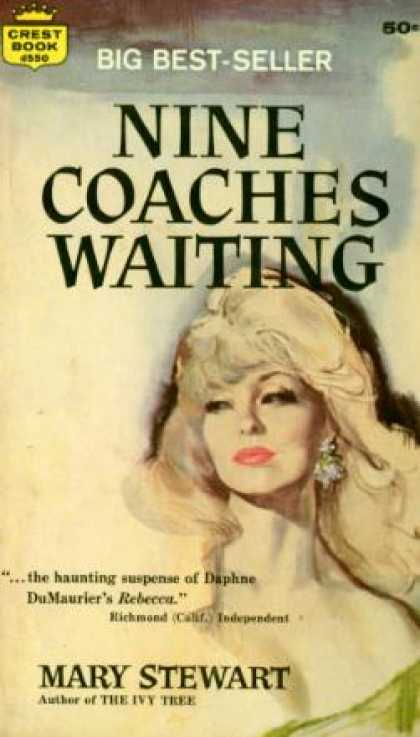
Does anyone remember having assigned summer reading back when they were in school? My mother often helped me out when I questioned the reasoning behind the selection of some of the books. When I complained about having to read "Nine Coaches Waiting," she patiently explained that my English teacher probably wrote a paper about that book, and as a consequence, the teacher did not have to do much preparation to discuss the story, and since the teacher knew it backwards and forwards, I had better read the whole thing. So, obeying my mother, I choked it down, and I hated it.

Thankfully, those school days are over. These days, I am left to my own devices when choosing what and when to read. Unfortunately, this places me in the role of being my own teacher, and that is not a wise choice of leadership. I pray that the Lord will lead me to good reading material. An interesting thread at StandFirm in Faith is available for those who wish to have a peek at the reading habits of others. There are a number of good suggestions there.

These days there are a number of good summer reads coming in the form of Internet publications. In the Summer 2009 edition of "Knowing and Doing," a publication of the C.S. Lewis Institute I was blessed to read,

C.S. Lewis and the Case Against Subjectivism
by Jerry Root, Ph.D. Adjunct Professor, Christian Formation and Ministry, Wheaton College

His paper is just 4 pages long, and even this simple pewster can follow his reasoning and even take away a few pearls. Here is one that shows up on page two of the .pdf file.
"Humility and honesty allow one to reason in community in ways that add perspective and corporate understanding. Evil, on the other hand, is destined to manifest itself in a culture leaning in the direction of subjectivism. Once an objective standard for morality is neglected, there is no longer any means for a proper appeal to objective reality whenever disputes arise; that is, there is no longer a way to settle disputes. Harmony is lost because the culture has no common tuning fork by which that harmony might be achieved."

Read the whole thing. Enjoy, and support the C.S. Lewis Institute!

P.S. After drafting this post, the subject of objective truth and how impossible it might be to discuss anything with those who deny such a thing came up over at the Anglican Curmudgeon's site. I commented on something that may pertain to this post as well. Here goes something,
During my lunch break, I chanced upon this collect in the 1928 BCP. I think it ties in with the subject of your post.

Offices of Instruction
FIRST OFFICE.

O ALMIGHTY God, Who alone canst order the unruly wills and affections of sinful men; Grant unto thy people, That they may love the thing which thou commandest, And desire that which thou dost promise; That so, among the sundry and manifold changes of the world, Our hearts may surely there be fixed, Where true joys are to be found; Through Jesus Christ our Lord. Amen.

The Curmudgeon points out that this collect is also in the 1979 BCP, as the "traditional" collect for the Fifth Sunday in Lent, p. 167.

(Be watchful for future BCP revisions to see if the "traditional collects" survive the revision.)

So, the summer reading questions for your book report presentation to the class are the following,
1. Is there an objective standard for morality?
2. Where is it to be found?
3. Is it contained in the Bible?
4. Is the Bible the Word of God?


Sorry class, but the teacher has probably written a paper about the subject, or at least a blog post, so, as Momma said, "You'd better read the whole Thing."

Sunday, November 23, 2008

What is This Kingdom Thing?

Fr. Dunbar gave us today's sermon. He did a good job, focusing on "the Kingdom." To me this was something the followers of Jesus just couldn't really understand during the time He was with them, in spite of all the questions presented to Him, and in spite of the parables He gave them. The Kingdom of the Lord was so unlike anything they expected, that I suspect It is still something that we also cannot put into words.

Today's readings of the separation of the sheep into those which will be saved and those that will be given over to Satan's fires were not directly addressed in the sermon. No one wants to hear about that aspect, the "other kingdom."

After the sermon, was anyone else more acutely aware (with their Sunday ears) of how many times the word "Kingdom" came up in the liturgy? And did anyone else pause and reflect upon the crowns in the lower left and lower right sides of the Epiphany window?
(I need a better picture, this one was from the ECOOS photo gallery)

The juxtaposition of the crown of thorns and the regal crown are a fitting way to think about the Kingdom, if you ask me, which you didn't.

Sunday, October 05, 2008

The N...nth Commandment


Fr. Dunbar gave today's sermon and used as his theme the 9th Commandment, you know the part about not bearing false witness. Narrowing the 10 commandments down and focusing on just one can be enlightening. As a nefarious, "in your face that's what he said" type of blogger, I have to always worry about the corollary command, "Thou shalt not be too honest." Or the other, "For heavens sake, don't write anything that might offend someone!"

Having discovered that it is impossible to not offend at least one person somewhere when expressing my personal opinions, I have been guilty of breaking both corollary 1and 2 on occasion.

The recent Vice-Presidential debate and the conflicting reports from the various news media pundits provided us with many challenges to the Ninth Commandment.

Isn't it interesting how different witnesses can present radically different stories about the same event, and none would be considered guilty of breaking Commandment #9 if they felt they were presenting the truth as they saw it.

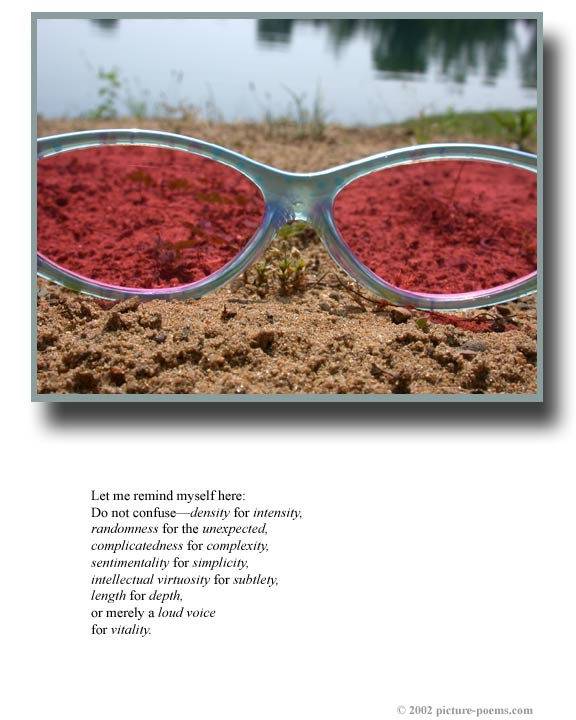
The truth as we see it is that which is viewed through our unique lenses, presented to our unique individual brain wiring and chemistry, and interpreted through the filters of past experiences and preconceptions.

To focus on the truth of a subject is to do away with all the lenses, filters, memories, etc. This is something more likely to lead to inner peace than reading blogs or listening to politicians "debate" can ever do as blogging is wired into the www and it's infinite resources of truths and untruths, and politicians are... well, I can't write the words right now for fear of corollary 1 and 2, so listen instead,


She is forgiven.

p.s. I hope the letter was from her Auntie.