With the recent failed attempt by Rowan Williams (the Archbishop of Canterbury) to stop the Episcopal church from widening the gulf between themselves and the Anglican Communion, and speculation mounting as to what response we might hear from Canterbury, the pewster recalled the song "London Calling" and wondered if I could help with an update.
"Rowan Calling" by Wallace Hartley
"Rowan calling to the purple shirts Now that war is declared-my ego is hurt Rowan calling to the underground Come out of the closet, all you lost and found Rowan calling, now don't look to us All that phony Biblemania has bitten the dust Rowan calling, see we ain't got no swing 'Cept for the spin of that thurible thing
CHORUS The dark age is coming, the sun is growing dim Evangelicals stop running and the wafers are thin A theological error, but I have no fear Rowan is frowning-and you just don't care
Rowan calling to the T.E.C. Forget it, brother, an' go it without me Rowan calling upon the zombies of death Quit holding out-and draw another breath Rowan calling-and I don't wanna shout But when we were talking-I saw you nodding out Rowan calling, see we ain't got no prayer Don't hold your breath, I'm still up in the air
CHORUS
Now get this London calling, yeah, I was there, too An' you know what I said? Well, none of it was true! London calling at the top of the dial After all this, won't you give me a smile?
Schism and schismatic are names Christians throw out at each other when they are really mad. It doesn't matter on which side of the canyon you stand, it is always the other side that caused the rift. One never looks down at the river that has been eating away at the bedrock. Nor do you look into the waters to see the dirt and grit contributing to the erosion. The process is usually so slow that it takes years to you discover the fact that you are no longer connected to the other side. At that point you shout out, "Schismatic" across the divide, and no doubt you will hear the word echo back upon yourself.
What is going on with the 2009 General Convention of the Episcopal church that is raising the cry, "Schism!"? The BBC reports,
"Bishops of the Anglican Church in the United States have voted to overturn a three-year moratorium on the election of gay bishops.
The decision seems likely to lead to the Episcopal Church's eventual exit from the worldwide Anglican Communion."
(Read: Schism)
The UK's Times OnLine had this headline from July 15, 2009:
The Americans know this will end in schism
Support by US Episcopalians for homosexual clergy is contrary to Anglican faith and tradition. They are leaving the family
How did the Episcopal Church get to this point, the point where our Bishops have "come out" and said, "Let us increase the gulf between us and the rest of the Anglican Communion."? What waters have done this, and from whence does the river flow? Many think the entire issue is over homosexuality. I like to think that those people are just looking at the rapids, and not the whole river. There is a current of liberal theology that is harder for people to recognize as it is what slowly erodes away the foundations of the church. This theology weakens the foundational authority of the same scripture that we believe contains all things necessary to salvation (Article VI). Allowed to run its course, a church standing beside the river of liberal theology finds itself divided. Tracing our river backwards, we spot one of the architechs of this divide was the nefarious Bishop John Spong, whose "Rescuing the Bible from Fundamentalism," along with his other teachings and actions, acted like abrasives poured into the already running waters. There are other individuals dotting the shorelines, but since he is intimately involved in the process, and homosexuality is the rocky shoal over which we are currently watching the church float, I will focus more on this part of the river than is usual for these pages.
There are more detailed time lines out there, but for the neophyte, this shorter version from the pages of Get Religion is a good starting place.
Terry Mattingly asserts that in order to write about the subject of homosexuality and the Episcopal church, you have to cherchez les Bishops when he wrote,
"When you are talking about the history of the Anglican wars, you really have to remember that it’s really about the bishops.
The Episcopal Church has been struggling with homosexuality — in its national meetings — since the 1970s. But the big signposts have been about the men and women in the purple shirts. Here’s a few.
1989 — Bishop John Spong, Diocese of Newark, publicly ordains first non-celibate, openly-partnered, homosexual.
1991 — Bishop Walter Righter, Diocese of Washington, D.C., ordains a non-celibate homosexual.
1994 — Bishop Spong drafted the Koinonia Statement defining homosexuality as morally neutral and affirming support for the ordination of homosexuals in faithful sexual relationships (signed by 90 bishops and 144 deputies). Spong publishes his 12 Theses, laying out an approach to faith without a transcendent, personal deity.
1996 — Both counts of heresy against Bishop Righter dismissed in an ecclesiastical court, which decides that there is “no clear doctrine” in the Episcopal Church relevant to the ordination of those sexually active outside of marriage.
1998 — The bishops at the global Lambeth Conference uphold traditional teachings on marriage and human sexuality. Then, 65 ECUSA bishops sign a pastoral statement addressed to lesbian and gay Anglicans.
2000 — Archbishops Emmanuel Kolini ( Province of Rwanda) and Moses Tay ( Province of South East Asia) consecrate Father Chuck Murphy and Father John Rodgers as missionary bishops to the U.S.
You get the idea, if you are looking at the revolution of the theological left or the counter-revolt by the right, you have to watch the bishops — starting in the 1970, but with the open warfare picking up in the 1980s and ’90s. That’s the timeline."
(emphasis added)
And I might update the time line: June 2009 The Anglican Church in North America is formed with Robert Duncan as Archbishop and Primate.
"Of course I am coming here with hopes and anxieties – you know that and I shan't deny it. Along with many in the Communion, I hope and pray that there won't be decisions in the coming days that will push us further apart. But if people elsewhere in the Communion are concerned about this, it's because of a profound sense of what the Episcopal Church has given and can give to our fellowship worldwide. If we - if I – had felt that we could do perfectly well with out you, there wouldn't be a problem. But the bonds of relationship are deep, for me personally as for many others."
Sorry Rowan, but TEC bishops went ahead and gave you the holy kiss off with the latest addition to the time line:
July 13, 2009 Episcopal House of Bishops passes resolution (D025)
CURRENT VARIANT Resolution: D025
Title: Commitment and Witness to Anglican Communion
Topic: Anglican Communion
Committee: 08 - World Mission
House of Initial Action: Deputies
Proposer: Ms. D. Rebecca Snow
Resolved, the House of Bishops concurring, That the 76th General Convention reaffirm the continued participation of The Episcopal Church as a constituent member of the Anglican Communion; give thanks for the work of the bishops at the Lambeth Conference of 2008; reaffirm the abiding commitment of The Episcopal Church to the fellowship of churches that constitute the Anglican Communion and seek to live into the highest degree of communion possible; and be it further
Resolved, That the 76th General Convention encourage dioceses, congregations, and members of The Episcopal Church to participate to the fullest extent possible in the many instruments, networks and relationships of the Anglican Communion; and be it further
Resolved, That the 76th General Convention reaffirm its financial commitment to the Anglican Communion and pledge to participate fully in the Inter-Anglican Budget; and be it further
Resolved, That the 76th General Convention affirm the value of "listening to the experience of homosexual persons," as called for by the Lambeth Conferences of 1978, 1988, and 1998, and acknowledge that through our own listening the General Convention has come to recognize that the baptized membership of The Episcopal Church includes same-sex couples living in lifelong committed relationships "characterized by fidelity, monogamy, mutual affection and respect, careful, honest communication, and the holy love which enables those in such relationships to see in each other the image of God" (2000-D039); and be it further
Resolved, That the 76th General Convention recognize that gay and lesbian persons who are part of such relationships have responded to God's call and have exercised various ministries in and on behalf of God's One, Holy, Catholic and Apostolic Church and are currently doing so in our midst; and be it further
Resolved, That the 76th General Convention affirm that God has called and may call such individuals, to any ordained ministry in The Episcopal Church,; and that God's call to the ordained ministry in The Episcopal Church is a mystery which the Church attempts to discern for all people through our discernment processes acting in accordance with the Constitution and Canons of The Episcopal Church; and be it further
Resolved, That the 76th General Convention acknowledge that members of The Episcopal Church as of the Anglican Communion, based on careful study of the Holy Scriptures, and in light of tradition and reason, are not of one mind, and Christians of good conscience disagree about some of these matters.
As I look at the Bishops' resolution, it show a resolve to part ways with the Anglican Communion. That, my dear friends, creates schism.
Our Bishop Henderson voted in favor of this resolution. His explanation is found here and concludes with:
"It may come as a surprise to some that I voted “yes” on the final version of the resolution in the House of Bishops. I did so with powerful, mixed feelings, and my sleep during the night was not sound. My thinking is this: it is critically important that (1) we leave B033 in place, and (2) that we reaffirm our commitment to, involvement in, and support of the entire Anglican Communion, its life, mission and ministry. I do realize that some intend to use the language of the sixth resolve to advance an agenda for which I believe neither we nor the other churches of the Anglican Communion is ready to endorse separately or corporately. However, the content of the resolution, taken as a whole, is more helpful than not."
Even though he says he wants to remain committed to the Anglican Communion, his actions will result in the advance of the liberal agenda, eroding the foundations of the church and widening the gap between us. I therefore count him as a schismatic, albeit a moderate one, or at least a schismatics' accomplice. One has to wonder if he has been groomed as a schismatic's apprentice for this very moment.
You will be hearing various interpretations of this resolution, but the long and the short of it is that you will never again hear the following verses at your Sunday services in our Episcopal church (insert sound of scissors here):
1 Timothy 3:1-13
1 This is a true saying, if a man desire the office of a bishop, he desireth a good work.
2 A bishop then must be blameless, the husband of one wife, vigilant, sober, of good behaviour, given to hospitality, apt to teach;
3 Not given to wine, no striker, not greedy of filthy lucre; but patient, not a brawler, not covetous;
4 One that ruleth well his own house, having his children in subjection with all gravity;
5 (For if a man know not how to rule his own house, how shall he take care of the church of God?)
6 Not a novice, lest being lifted up with pride he fall into the condemnation of the devil.
7 Moreover he must have a good report of them which are without; lest he fall into reproach and the snare of the devil.
8 Likewise must the deacons be grave, not doubletongued, not given to much wine, not greedy of filthy lucre;
9 Holding the mystery of the faith in a pure conscience.
10 And let these also first be proved; then let them use the office of a deacon, being found blameless.
11 Even so must their wives be grave, not slanderers, sober, faithful in all things.
12 Let the deacons be the husbands of one wife, ruling their children and their own houses well.
13 For they that have used the office of a deacon well purchase to themselves a good degree, and great boldness in the faith which is in Christ Jesus.
Snip, snip, snip, and that is the sound of schism.
(Gigli was a forgettable Ben Affleck movie from 2003)
Falstaff: "The better part of valour is discretion; in the which better part I have saved my life."
(Shakespeare, Henry IV)
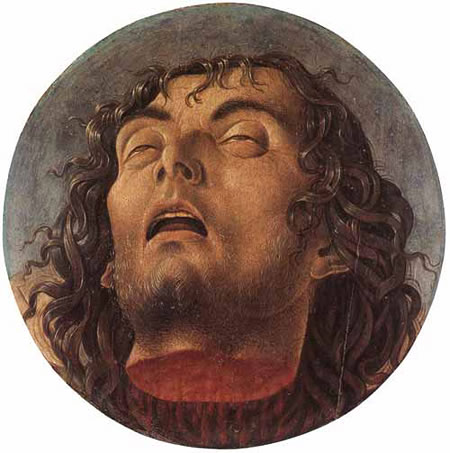
The Rev. Mary Cat Young was our preacher today, and she had the task of performing a double baptism after reading the tale of the beheading of John the Baptist and his head being served up on a platter to Herodias. I want everyone to consider how they might handle this problem. Mary Cat honestly said that it was too gruesome a thing to preach about before a baptism and used her discretion by talking instead about her own baptism. Maybe she was right to do so, for if you can't do it, admit it and go on rather than gross out the congregation and visitors with too many graphic details.
One thing can said for liberal preaching, it is intended to make you feel good. So why do I often come out with that uncomfortable feeling that something is missing or wrong? Maybe because there is an unsaid suggestion that we in the pews should not hear talk of headless baptizers, bloody battles, sin, the fear of God, or the wrath of God. Or that such talk keeps people from hearing the Gospel message of hope and love. I believe this is a reason why many Sunday services in the Episcopal church will leave out some of the "ugly bits" in either the Psalter, or the O.T. reading, the reading from the Epistles, and, of course, from the sermon. For years, I was content to listen to this expurgated version of Christianity, and was falling into the classic trap of believing that God's goodness should fall within my human understanding of goodness. To hear the story of John is painful to us. Where is God's goodness in that? Many believe that pain cannot be good, so let's not talk about those painful bits. How can people get over the indoctrination of "feel good" worship and be able to explain Christianity to their disbelieving friends and acquaintances? Shouldn't we study those painful passages in more detail and try to reconcile them with the loving passages?
Today's lessons showed us, quite graphically, the cruelty of sin, and the power that authorities hold over our lives. Of course, Jesus proved that He, not earthly kings like Herod, has the power over life and death. But still, the question of pain occurring to good people, such as John's imprisonment and beheading, comes up. Was it his fault due to a lack of discretion? Did he have to die? How can we explain it? Do we run from the problem?
No!
"Once more unto the breach, dear friends, once more"
(Shakespeare, Henry V)
I for one can't run from that awful image of John's disheveled face and bloody neck on a platter. It seems to me to be a problem of getting past the picture. I tried to get past it by looking into the root causes of evil and cruelty, the Christian response to evil, and how to get from point A to point B. I looked at today's Gospel reading and saw a story that shows us how the world treats prophetic witness, and the story made me examine why God's world works in this way. Then I looked at how John's baptismal ministry is remembered, and how, through Jesus, we are given the sacrament of Baptism. And maybe in the course of my exploration, I saw one of God's miracles. The miracle that we witnessed today: two people, one a child, the other an adult, are now, through the sacrament of Baptism, part of the body of Christ. I witnessed them renounce Satan and turn away from the forces of sin and evil. Those forces that threaten all that is good. Only through a miracle can such forces be overcome.
Bishop Gene Robinson was practicing his "narrative" the other day at the 2009 General Convention of the Episcopal Church. After he said, “...the god that I worship is a god that wanted the outside of me to agree with the inside of me…” I couldn't help but think of this song from The Who's Quadrophenia album.
5:15
"Why should I care, why should I care?
Girls of fifteen Sexually knowing The ushers are sniffing Eau-de-cologning The seats are seductive Celibate sitting
Pretty girls digging Prettier women. Magically bored On a quiet street corner Free frustration In our minds and our toes Quiet stormwater My generation Uppers and downers Either way blood flows.
Inside outside. Leave me alone. Inside outside. Nowhere is home. Inside outside, Where have I been? Out of my brain on the five fifteen.
On a raft in the quarry Slowly sinking. On the back of a lorry Holy hitching. Dreadfully sorry Apple scrumping. Born in the war Birthday punching.
He man drag In the glittering ballroom Greyely outrageous In my high heel shoes Tightly undone They know what they're showing Sadly ecstatic That their heroes are news.
Why should I care?"
I have to pull out the old LP to double check those lyrics, but for the most part they seem accurate.
(Update, I had to change "gravely" to "greyly," I knew something was wrong.)
Of all the comments at StandFirm on this subject, I liked the following best:
"Good lord I hope my inside never agrees with my outside (or vice versa). I am such a mess, I need to put the whole thing in control of God and ask Jesus to help get me there through the power of the Holy Spirit. There was a time in my life when 'I was in control'. Never, ever want to go there again!" [22] Posted by Capt. Deacon Warren on 07-10-2009 at 12:32 PM
Update:
This comment by #28 Eddie Swain was good too:
"God wants us to have Jesus on the inside and then to work towards making the outside agree with that. But, when the inside and outside don't agree, it is because of our own lack of integrity (and, more precisely the existence of sin in our lives.
VGR's viewpoint is that because he percieved himself as gay inside, that must be how God made him. Therefore, he needs to be open and honest about his homosexuality, else he would be accusing God of not having integrity.
The fact is that, for someone like VGR who grew up in the Church, he had this nagging thing called the Holy Spirit on the inside that was conflicting with his external desires for sinful pleasure (just like all of us sinners). The difference is that VGR decided to achieve personal integrity by giving in to the outside desires and then projected the whole 'integrity' stuff on to God to justify his behavior.
Now, he thinks he is living a life of integrity because his "inside" agrees with his 'outside.' The ironic thing is that by claiming that God is okay with this (blessing his sinful behavior), he is actually portraying a god that has no integrity. The God of the Bible is clearly opposed to sin (including homosexual behavior)."
I apologize for placing so many links in this posting.
As the Episcopal Church's General Convention 2009 kicks off today, I was thinking about how modern secular issues interact with religion. This interaction is unavoidable, and dealing with issues is, in my opinion, part of the "mission" of the Church.
As thoroughly modern Episcopalians, we have been instructed to examine the Scriptures, Tradition, and Reason when asked where we "stand" on the issues. Often times, people lean too heavily on one of the legs of this "three legged stool," and as a result they can tip over. In 2009, we are increasingly being asked to look at "Justice" as well, thus creating a wobbley four legged chair.
As one who tends to rely on the first 2 legs, I frequently fall because I short change Reason. I believe this is mostly due to my poor skills at chess and other such mental gymnastics. At other times I fall because of lack of knowledge of traditional teachings, and at other times it is because of the sin of not knowing the Scriptures. As far as "Justice" goes, I defer to Fr. Dan Martin's recent post found here.
As the Episcopal Church marches on with its Reason/Justice based agenda despite the warnings of Tradition and Scripture, I continue to ponder what "Rights" will become "Rites," and what "Rights" will become "Sacraments" in the future.
First a little background on the sacraments. Thumbing through the BCP, as I often do in my spare time, I recall that we answer the questions in the Catechism (pages 858-861) about sacraments by stating that there are two "great sacraments given by Christ" (Holy Baptism and Holy Eucharist) and there are five others that are sacramental rites that "evolved" under the guidance of the Holy Spirit (Confirmation, Ordination, Holy Matrimony, Reconciliation of a Penitent, and Unction of the Sick). Also please see Article XXV on page 872 for the "historical" description of the sacraments with the last five using the Catholic terminology and described as in part "states of life allowed in the Scriptures." These are essentially the same ones we inherit from the Council of Trent. I defer to the Catholic Encyclopedia,
The Council of Trent solemnly defined that there are seven sacraments of the New Law, truly and properly so called, viz., Baptism, Confirmation, Holy Eucharist, Penance, Extreme Unction, Orders, and Matrimony. The same enumeration had been made in the Decree for the Armenians by the Council of Florence (1439), in the Profession of Faith of Michael Palaelogus, offered to Gregory X in the Council of Lyons (1274) and in the council held at London, in 1237, under Otto, legate of the Holy See. According to some writers Otto of Bamberg (1139), the Apostle of Pomerania, was the first who clearly adopted the number seven (see Tanquerey, "De sacr."). Most probably this honour belongs to Peter Lombard (d. 1164) who in his fourth Book of Sentences (d. i, n.2) defines a sacrament as a sacred sign which not only signifies but also causes grace, and then (d.ii, n.1) enumerates the seven sacraments. It is worthy of note that, although the great Scholastics rejected many of his theological opinions (list given in app. to Migne edition, Paris, 1841), this definition and enumeration were at once universally accepted, proof positive that he did not introduce a new doctrine, but merely expressed in a convenient and precise formula what had always been held in the Church. Just as many doctrines were believed, but not always accurately expressed, until the condemnation of heresies or the development of religious knowledge called forth a neat and precise formula, so also the sacraments were accepted and used by the Church for centuries before Aristotelian philosophy, applied to the systematic explanation of Christian doctrine, furnished the accurate definition and enumeration of Peter Lombard. The earlier Christians were more concerned with the use of sacred rites than with scientific formulae, being like the pious author of the "Imitation of Christ", who wrote: "I had rather feel compunction than know its definition" (I, i).
Since the General Convention of the Episcopal Church 2009 will discuss resolutions aboout creating new rites and blessings, I wondered where it could possibly end. Being certain that someone had thought of this before, I went searching for a list of modern sacraments of secular culture. Here is one list I found. It was written by Catholic Bishop Thomas Doran of Rockford in 2006 (I added a few choice links for those unfamiliar with the terms),
His list summarizes some of the issues that the secular world has blessed. Can anyone come up with a way of integrating the secular sacraments with religion? Oh yes, I have a list in mind. I will place the "historical" sacraments alongside the "Brave New" ones.
1. Baptism : This will probably stay but let's change the name to a sacrament of Self-Improvement. 2. Confirmation : Dropped because this is 1. not needed in an age of open communion (see sacrament #3 below), and 2. non-inclusive and discriminatory against Muslims/etc. 3. Holy Eucharist : This one will probably stay but will be renamed "Open Communion" or "Happy Meal." 4. Penance : Since there is nothing for which to be penitant, this will be changed to the sacrament of the MDGs to reflect the collective guilt of the Church. 5. Extreme Unction : This will need an additional sacrament of Euthanasia . 6. Orders : New sacrament of C.H.A.O.S. 7. Matrimony : The "Holy" will be dropped and new sacrament called "Love the One You're With" will be put in its place.
When things get worse, in place of 1, and 2 I suggest 1. Bishop Doran's Rite for Abortion (Believe it or not, this Liturgy has already been written (paid for in part by the Episcopal Church). You can see it here (H/T Standfirm), 2. Divorce (This liturgy appeared on the Episcopal Church's site under the Office of Women's Ministries a while ago but was removed.)
I am still thinking that more will be added. I am open to suggestions. So is GC 2009, they appear open for anything.
In the spirit of the "Ubuntu" theme for the convention, I pray they don't fuss or fight. And please no Ubuntu Kung Fu.
Southern Saying: I declare. Translation: I did not know, or that is surprising, or it can merely be used when there is really nothing else to say. Usage: I declare!
Today at ECOOS, the Rev. Mary Cat Young gave the sermon. It offered her another chance to relate her mission trip activities, this time a trip to the hurricane recovery areas of Bay St. Louis Miss. and NOLA. I give her points for trying to forge a link with the Gospel of Mark. Although there could have been more said, I am tempted to say, "I declare" because there really is nothing else to say. But, being a stinkin pewster, I started to sniff around the edges of her homily to find anything that the sermon made me think about.
First thought: Sailing into the storm on Bay St. Louis.
Second thought: Read the Gospel again! (Mark 6:1-13)
(Verses 3-13 here)
Is not this the carpenter, the son of Mary and brother of James and Joses and Judas and Simon, and are not his sisters here with us?’...
(I wonder if Mary Cat could have tied in the carpenter description with some of the handiwork her High Schoolers performed on their trip?)
And they took offence at him. Then Jesus said to them, ‘Prophets are not without honour, except in their home town, and among their own kin, and in their own house.’ And he could do no deed of power there,...
(A possible justification to leave town to do missionary work).
...except that he laid his hands on a few sick people and cured them. And he was amazed at their unbelief.
(You don't have to travel very far to find unbelievers, but you might have to walk a few miles to find some who will believe).
Then he went about among the villages teaching. He called the twelve and began to send them out two by two, and gave them authority over the unclean spirits. He ordered them to take nothing for their journey except a staff; no bread, no bag, no money in their belts; but to wear sandals and not to put on two tunics.
(She did touch on this one. Unlike the twelve, Mary Cat's group did take sleeping bags along on their journey).
He said to them, ‘Wherever you enter a house, stay there until you leave the place. If any place will not welcome you and they refuse to hear you, as you leave, shake off the dust that is on your feet as a testimony against them.’ So they went out and proclaimed that all should repent. They cast out many demons, and anointed with oil many who were sick and cured them.
That last part has the difficult bits, and although they do not relate to the Sr. High student's trip to the Gulf coast, and were not a subject of the sermon, they made me pause. First, the "testimony against them" part is so politically incorrect. Who in this day and age, when all religions and beliefs are considered equally acceptable to God, would dare to testify against an unbeliever? Aren't we supposed to support each other? Doesn't that extend to granting at least silent approval of their unbelief? Second, that casting out of demons stuff is so passe. Everybody knows there are no such things as demons. Even if there were, where would you cast them anyway? There probably isn't any such thing as the supernatural either, so we would be making those demons homeless. Third, imagine anointing the sick with oil. We are so beyond that kind of hocus pocus, and besides, the use of oil expands our carbon footprint and makes us dependant on foreign countries (Oh, sorry, they didn't use that kind of oil).
When I re-read today's lessons and recall Mary Cat's sermon, I am left wondering how we are to interact with an increasingly unbelieving world. Have I been prepared by my church to answer the challenges presented to us by the naysayers and the skeptical?
Has my church sufficiently grounded me in Christ to defend His name?
Or should I just keep being a "good person" and be a silent example for Him?
To the last question I say, "No!" A vision of the rocks themselves refusing to be silent came to mind: Luke 19:37-40
"And when he was come nigh, even now at the descent of the mount of Olives, the whole multitude of the disciples began to rejoice and praise God with a loud voice for all the mighty works that they had seen;
Saying, Blessed be the King that cometh in the name of the Lord: peace in heaven, and glory in the highest.
And some of the Pharisees from among the multitude said unto him, Master, rebuke thy disciples.
And he answered and said unto them, I tell you that, if these should hold their peace, the stones would immediately cry out."
I declare! Praise to the Father, Son, and Holy Ghost!
"A handful of 'progressive' Episcopal women want to ban Anglicans, Lutherans, and Roman Catholics from the Order and make it an Episcopal Church-only organization. They have targeted the elected president of the Order, Joan Dalrymple, but frankly, I have to wonder if the real target is the national Chaplain, none other than the Rt. Rev. John W. Howe, Bishop of Central Florida. He's been making peace of late with those parishes and clergy who seek to separate from the Episcopal Church. And now we have Washington-style politics going on, with whispers of financial mismanagement (absurd, you can read their financial statements yourself here - including the audit) as well as an entire shadow website put up online as a "shadow" Order (sound familiar friends?).
At the Daughters of the King Triennial, held in 2006, the delegates voted to interpret the bylaws strictly so that each chapter had one vote. The bylaws do not recognize 'Episcopal' and the Order is not an official part of the Episcopal Church. It's like the Alpha Course - it's associated with Episcopal Churches, but is a separate entity. The Triennial voted by an overwhelming majority of 219 to 30 to seat Roman Catholic, Lutheran, and Anglican Chapters."
BB gave us an update this past week by posting the following on June 27, 2009.
"Since the Triennial, a small group formed calling themselves the 'Episcopal' Community of the Daughters of the King and they seek to expel from the Order all the Anglican, Lutheran, and Roman Catholic members. They have recruited bishops from the Episcopal Church to pressure the president of the DOK, continuing the whisper campaign to cast a cloud over her leadership.
Proposed bylaws being submitted by a faction called the 'Episcopal Community' is seeking to expel the non-TEC members from the Order of the Daughters of the King.
The draft bylaws now being circulated in anticipation to next month's Triennial include entire sections of the current by-laws rewritten so that those non-TEC members who are in the Order now will be expelled from membership.
The draft reads, 'All members must be women communicants of The Episcopal Church (hereinafter referred to as TEC, formerly known as the Episcopal Church of the United States of America) . At no time shall any non-TEC person have seat or voice or vote or hold office or serve as chaplain in TEC Daughters of the King.'"
Baby Blue's suspicions about the chaplain concerns seem to be borne out.
In addition, the wearing of the Daughters of the King cross will only be granted to so-called 'parallel structures' (separate but equal?) by explicit permission of the Presiding Bishop of The Episcopal Church following a rigorous consent process of the Episcopal-only membership. 'Non-TEC parallel Orders may ... apply to the full National Council of TEC Daughters of the King'"
I am not familiar with their articles of incorporation (if any) but are they changing the name to "TEC Daughters of the King?"
"for a license to use the name, cross, and such other items as may belong to this Order,' reads the Episcopal Community draft Article IV:I. 'The decision of the National Council to grant such license must be ratified by the membership and consented to by the Presiding Bishop of TEC.'"
Is this in keeping with an "Inclusive Church?"
Does this create a new job description for the P.B.?
Is there any chance this will pass?
To me this looks like another power play by the Presiding Bishop. Let us pray that she is not party to this proposed bylaws change, but would the "Episcopal Community" dare to presuppose that the Presiding Bishop would take time from her busy schedule to deign her permission to certain non-Episcopalians to wear the cross? This makes me think that they had discussed this matter with 815 and have the blessing of the P.B. It should be interesting to watch how this story unfolds. Keep us posted, Baby Blue!
I'm a passionate Christian, fiercely devoted to Jesus Christ and his Church. I am willing to labor long hours in the Lord’s vineyard, and I have little patience with those who are less willing or able to work as I do. My passions often carry me into temptation zones of wrath, lust, and pride.
They Are Awake, Not Woke
-
A dozen voices warning about Islamic expansionism: The Islamic takeover of
the West continues apace. While suits and ballot boxes (aided and abetted
by c...
Elections and Jeffersonians
-
I generally try to avoid politics on this blog because it has always been
fairly religiously oriented. My over-arching political mantra is Salvation
come...
From the archives - 6
-
Tuesday, 23 November 2021 Red Wednesday 2021
Red Week highlights persecuted Christians, ‘fundamental right’ of religious
freedom OSV News
A Bishop Goes Down
-
The following is from an e-mail from the ACNA College of Bishops, The
College of Bishops of the Anglican Church in North America deposed Derek
Jones from t...
Anglican Church of Canada, proudly irrelevant
-
There is one thing the Anglican Church of Canada does well: falling
gurgling into the backwash of the zeitgeist wave while convincing itself
that it is bla...
The Commandments of Love
-
Hear what the Lord God commanded: “Take a lamb for each household, and make
of it a feast, with unleavened bread and bitter herbs, and mark your
doorways...
THE END
-
Due to a recent health scare it has been decided that it would not be wise
for me to continue with Grain. I hope soon to be able to contribute the
occasion...
Pigeons Pt. 2
-
And he told those who sold the pigeons, “Take these things away; do not
make my Father’s house a house of trade.” His disciples remembered that it
was writ...
Compline (Night Prayer) - Monday, 28 August 2023
-
In the beginning there was nothing - and God (Father, Son and Holy Spirit)
sang and it was: Creation was!
Tonight may the Godhead sing over you and bring y...
ECUSA Attempts an End Run in South Carolina
-
Last week, in a brazen maneuver to cut matters short in the South Carolina
litigation, the Episcopal Church (USA) and its ersatz diocese filed a
request, i...
The end of Christianity?
-
By CEN The persecution of Christians worldwide has never been more severe.
A few examples will give you the flavour of what’s happening… Islamic State
turn...
Leithart: Bring back ordination in chains
-
Peter J. Leithart (*Against Christianity*, pp. 117-118) longs for the days
when pastoral candidates were not so enthusiastic about jumping into the
fray. W...
Homily for Remembrance Sunday - Two Sacrifices
-
One hundred years to the day when the Great War ended we find ourselves in
this church to pray and to remember. And here we are invited to look at a
rare,...
"Marriage and Baptism Go Together"
-
As an observer from my ACNA lifeboat, I get to witness to the death throes
of the S.S. Episcopal with every passing piece of flotsam and jetsam that
drift...
2018 General Convention: Wrap-Up
-
Back home now, recovering a sense of normalcy after the hothouse
environment of General Convention, and getting ready to take myself out of
action for a ab...
14%
-
14%. The number seemed a bit low to me, but that may be based on my
assumptions in coming out of a Free Church background. However, in a
non-scientific inf...
When Beauty Saved the World
-
If gymnastics is coming from your soul, then you will be an unforgettable
gymnast… ~ Natalia Yurchenko During this past summer’s Rio Olympics there
was dis...
The trial... was it worth it??
-
Once the injunction was put in place, it was inevitable that litigation
would ensue... which it did. The nearly two week trial ended in late July
(25th). A...
Sabbath Rest
-
I've been anticipating something like this to post for quite a bit of time
now but it seems that the time has come to do it.
It seems that the time has com...
Christrian Csomology; Incarnarion and 'Evil'
-
The topic of CChristinan Cosmology continues to fascinate me because in
presenting the demands of the gospel, a I hope to tomorrow, THW Baia on
qhixxh we ...
Stay Apace
-
PROGRESS: Writing notes on paper, sealing them in an envelope beneath wax
and a signet ring, and sending them out with a courier on horseback solely
to kee...





 Posts


