Wednesday, June 02, 2010

A Lily's Last Stand?

Landsford Canal State Park is one of South Carolina's secret destinations this time of year. A 20 minute drive from Rock Hill, the park is home to a huge stand of "Rocky Shoals Spider Lilies." These interesting plants live in the middle of the Catawba river and thrive in the shallow, running waters at the site of a early 19th century canal project. May is the season for these flowers to bloom and I am reminded of part of today's lectionary reading from Ecclesiastes 3:1-15,
For everything there is a season, and a time for every matter under heaven:
a time to be born, and a time to die;
a time to plant, and a time to pluck up what is planted;
a time to kill, and a time to heal;
a time to break down, and a time to build up;
a time to weep, and a time to laugh;
a time to mourn, and a time to dance;
a time to throw away stones, and a time to gather stones together;
a time to embrace, and a time to refrain from embracing;
a time to seek, and a time to lose;
a time to keep, and a time to throw away;
a time to tear, and a time to sew;
a time to keep silence, and a time to speak;
a time to love, and a time to hate;
a time for war, and a time for peace.

There was an time for canal building in America. That time has past, and as the writer of Ecclesiastes might say, "All was vanity." The canal itself no longer exists, but the stone ruins of its guard locks can be viewed just a short walk from the park entrance.


Taking the nature trail for another half mile would lead to a lookout area to view the spider lilies,


but the canal trail looked quiet and inviting.


Maybe next time. This was May 29th and the lilies were in bloom. I am afraid that my pictures don't do the vista justice.


Lilies have been associated with funerals which I suppose is because they symbolize the purity and innocence of the redeemed Christian soul.


These lilies, constantly bathed by the flowing waters of the Catawba seem especially appropriate symbols of our eternal life and the means of our redemption.


Another way to see the lilies is by canoe or kayak. Just put in at the park picnic area, float downstream, and take out at the lower parking area. Because the waters are shallow and rocky, (hence the need for the canal) it is best to use an older vessel for your voyage. Next year I am going to bring the kayak I bought at a city auction a few years back, the one with "Rock Hill Rocks" printed on the side and plenty of dings in its bottom.

The spider lilies also can be found in Columbia,


but the "wow" factor at Landsford Canal State Park is worth the trip. See you next May!

(Click on the pictures to enlarge them).

Sunday, May 30, 2010

Trinity Flower

Today is "Trinity Sunday." Instead of a sermon where the doctrine of the Trinity was discussed, our sermon took a more down to earth approach by examining a recent triad of funerals in our extended family. I don't know if the number (three) was chance or not, but the coincidence did get me thinking about all of those little trinities that go past unnoticed.

Just yesterday, I was on a hike in the woods, and my attention was drawn to several Trinity flowers. I stopped and took a photo, but was unable to get a good image of the small flower. Here is one from Finegardening.com


Trillium pusillum
Also known as the Dwarf wakerobin, or Wood lily.

There is always something more to reflect upon, and the picture above was no exception.


The little worm hanging onto the Trinity flower's leaf reminded me of our place around the beauty of the Holy Trinity. Much like the worm, we hang onto the Trinity, and in a way, we are nourished by both the doctrine and the deeper meaning of the Trinity. Oh yes, the Trinity flower does bear fruit, but that is an unseen hope of the flower in this image.

One of today's readings was Romans 5:1-5, and hidden therin lay another little trinity flower:
"...suffering produces endurance, and endurance produces character, and character produces hope..."

To all who hang on to the tip of the leaf, the hope of the flower awaits.

____________________________________________________________________________

As part of our ongoing series on "missing verses," I noticed that the Revised Common Lectionary omitted parts of the O.T. reading today. This time omitted was Proverbs 8:5-21 (for some reason the reading was Proverbs 8:1-4,22-31).

5 O simple ones, learn prudence;
acquire intelligence, you who lack it.
6 Hear, for I will speak noble things,
and from my lips will come what is right;
7 for my mouth will utter truth;
wickedness is an abomination to my lips.
8 All the words of my mouth are righteous;
there is nothing twisted or crooked in them.
9 They are all straight to one who understands
and right to those who find knowledge.
10 Take my instruction instead of silver,
and knowledge rather than choice gold;
11 for wisdom is better than jewels,
and all that you may desire cannot compare with her.
12 I, wisdom, live with prudence,
and I attain knowledge and discretion.
13 The fear of the Lord is hatred of evil.
Pride and arrogance and the way of evil
and perverted speech I hate.
14 I have good advice and sound wisdom;
I have insight, I have strength.
15 By me kings reign,
and rulers decree what is just;
16 by me rulers rule,
and nobles, all who govern rightly.
17 I love those who love me,
and those who seek me diligently find me.
18 Riches and honour are with me,
enduring wealth and prosperity.
19 My fruit is better than gold, even fine gold,
and my yield than choice silver.
20 I walk in the way of righteousness,
along the paths of justice,
21 endowing with wealth those who love me,
and filling their treasuries.


From one character to another, the fruit that is better than gold awaits the one who hangs on to the end.

Wednesday, May 26, 2010

Chastity Redefined

Roman coin, (Pvdicitia- Modesty, virtue or chastity from "Reverse Personifications" at celatorsart.com)

The control over the meaning of words is a little recognized bit of gamesmanship that goes on at all levels of our society. In religion, he who writes the definitions can use redefinition as a means of supporting a new innovation. This week, I witnessed a good example over at T19.

Canon Kendall Harmon posted an excellent response to a posting at the Episcopal Cafe entitled "Chastity, now" by Richard Helmer+ the rector of the Church of Our Saviour in Mill Valley California. Before you head to Kendall's blog, read a little sample of the Rev. Helmer's post:

"In starting discernment to become a member of a spiritual community of The Episcopal Church, I have been invited in recent months to study the three classic evangelical counsels as they have been articulated as vows beginning with the mendicant orders in the twelfth century: poverty, chastity, and obedience.

As a parish priest, husband, father, and ever aspiring pianist, the one counsel that has captivated me most recently has been the vow of chastity. It has spoken most deeply to my perfectionistic desire to control outcomes in every relationship in my life -- far beyond its often narrow interpretation regarding fidelity in sexual conduct.

Chastity means setting aside dominance and control and seeking instead a new way to relate to the world and to God."


Aren't there other terms to use to describe that? Now why would anyone try to redefine chastity?

You have to wade through the rest of the post before we see where he is headed,
"But there is good news. Chastity has been in evidence in the increasing number of voices of those who recognize our disagreements as a Communion, but yet insist that costly communion in Christ is far more valuable than agreement.
Chastity has long been in evidence by those courageous, oft-threatened 'firsts' of our faith who inhabit dangerous positions not for power or the quixotic pursuit of perfection, but simply by being who they are and following God's call as best they can. The consecrations in the Diocese of Los Angeles are some of the most recent examples of this form of chastity."

Consecrating a partnered lesbian as bishop is the antithesis of chastity even as Helmer defines it. That action is all about exercising control and power over us pewsitters by imposing a radical new thang totally unsupported by apostolic tradition and scripture.

Little did I know when I first responded to Kendall's post that The Rev. Helmer would stop by and contribute to the comments. I had an interesting exchange with him, but some of the best written comments came from others. For example, a certain commenter, Billy, was far better able to put down in words what many of us were trying to examine in our earlier comments,
"I appreciate Mr. Helmer's defense on this thread, but I have to say that what he is saying is really nothing more than, "I'm OK, You're OK," with all the concomitant easing and changing of standards of conduct and civilization that book helped to bring about in the 70s. His is the same redefining of a word, "chastity," because the traditional definition of that word carries a standard of behavior that does not fit into the current world of homosexual conduct (or much heterosexual conduct, for that matter).
A few years ago, a reappraising priest explained to me, when I asked him his definition of "fornication during a discussion of homosexual conduct," that it was sexual relations outside the order of life-long giving, sacrifice, and commitment. So for him, reservation of sexual relations for heterosexual marriage was irrelevant. He expanded the traditional definition of fornication to a much broader definition because the standard of conduct for the traditional definition did not fit into homosexual "committed" relationships. Mr. Helmer similarly expands and changes the definition of "chastity" to include Ms Glasspool's conduct. For otherwise, under traditional historic understood definitions, how could she remain a priest, much less be consecrated a bishop. Additionally, I would note that if chastity is giving up dominance and control, as he defines it, then it follows that sexual relations are maintaining dominance and control. In some instances that may be true, but as Kendall points out, that is only partial truth, which goes further to show that the definition is unworkable for the word attempting to be used. This partiality of truth, also, gives further evidence that the definition is being changed for a specific reason, that is to try to zero in on the claim that calling others, especially homosexuals, to chastity is just trying to dominate and control them - that is the how and why, as Kendall points out, but has nothing to do with the what, the sexual conduct, itself. But note, also, that Mr. Helmer admits in his new definition of chastity, that it requires one to adopt a new way to relate to the world and to God ... and when he specifically applies it to Ms Glasspool and her sexual relationship with her partner, he is specifically saying that acceptance of this requires a new way to relate to her AND TO GOD. Certainly it does require a new way to relate to her ... that is the I'm OK, You're OK acceptance of a different and, according to my traditional understanding, immoral standard of conduct. But to require a new way of relating to God, that's a lot to swallow and provides increased evidence that Mr. Helmer is changing the definition of this word for the specific purpose of requiring our church members to accept homosexual conduct as blessed and holy - which is, ironically, the exact opposite of his own made-up definition. For he is attempting, in his article, as an authority in the church - a priest - to "dominate and control" those of us who cling to the traditional definition of the word, in the same way any priest dominates and controls the laity by his/her interpretation of how we are to relate to God and to each other."


Now run on over to Kendall Harmon's response and don't miss the comments where you will find at least two alternative words that others proposed which might be a better fit for the Rev. Helmer's definition: love and humility.

Sunday, May 23, 2010

Where's the Fire?

Someone asked me what I was doing yesterday in lieu of attending the consecration of Bishop Waldo. I responded quite honestly that I was gathering firewood for the winter. In fact, I left home just as the webcast started. It was terribly hot and humid as I hauled logs from a ridiculous hollow on our property where those sweet and kindly Duke Power crewmen had left them. Thinking of the people in Greenville listening to all that wonderful music made me feel a little bit like the fabled ant. Returning home I listened to the reports about the pomp, circumstance, as well as the pickin and fiddling. One thing Episcopalians can do, and that is put on a good show, and I am afraid that much of what we do is just that, all show. Episcopalians can also put on some very bad shows. The recent disgraceful consecration of Mary Glasspool in Los Angeles for example (see Fr. Matt Kennedy's post, Mother Earth, Pagan Rituals, Ancestor Worship, Dancing Girls—the Consecration of Mary Glasspool, at StandFirm in Faith, but I warn you the video is just as Fr. Matt has labeled).

Speaking about fiddling as the city burns, today at ECOOS we had a report from the Finance Committee on the state of the budget. Facing a shortfall in pledge payments and plate offerings as we start the dry months of summer, the vestry is faced with the option of dipping into reserves or taking out a line of credit to cover expenses, and this is after withholding our diocesan pledge. As the largest church in our convocation, will that kind of report get bishop Andy to lay down his fiddle, or will he just blame the fires on the Christians.

Is there a spirit of fear and anxiety in ECOOS over the budget deficit? I think not, after all, summertime deficits are nothing new. A few years back during another crisis, one parishioner told me that he was not going to increase his pledge because it was good for the church to be hungry.

Today's sermon began with an self admitted diversion into 60's psychology. In the words of our rector, we are suffering from the "four demons of the apocalypse, fear, anxiety, guilt, and shame." He was flashing too far back into the sixties for me when he tried to explain away shame and guilt, but I could think back to several Bible verses to understand that there is no need to have fear or anxiety.

"Fear thou not; for I am with thee: be not dismayed; for I am thy God: I will strengthen thee; yea, I will help thee; yea, I will uphold thee with the right hand of my righteousness." Isaiah 41:10

"These things I have spoken unto you, that in me ye might have peace. In the world ye shall have tribulation: but be of good cheer; I have overcome the world."
John 16:33

"God is our refuge and strength, a very present help in trouble. Therefore will not we fear, though the earth be removed, and though the mountains be carried into the midst of the sea."
Psalm 46:1-2

"For God hath not given us the spirit of fear; but of power, and of love, and of a sound mind." 2 Tim 1:7

"Casting all your care upon him; for he careth for you." 1 Peter 5:7


The rector did not quote any of these verses, but instead gave us a general message that the Holy Spirit was "all about peace," and I guess from that we are supposed to take comfort. When he focused on the peace of the Holy Spirit, my mind flashed back to the reading from Acts 2:1-2 with its images of tongues of flaming fire, and portents in the heaven above and signs on the earth below, blood and fire, and smoky mist, the sun turned to darkness and the moon turned to blood. As the rector went on and on about the peace that the Holy Spirit brings, I could not help but think of Matthew 10:19-28,

"But when they arrest you, do not worry about what to say or how to say it. At that time you will be given what to say, for it will not be you speaking, but the Spirit of your Father speaking through you.

Brother will betray brother to death, and a father his child; children will rebel against their parents and have them put to death. All men will hate you because of me, but he who stands firm to the end will be saved. When you are persecuted in one place, flee to another. I tell you the truth, you will not finish going through the cities of Israel before the Son of Man comes.

A student is not above his teacher, nor a servant above his master. It is enough for the student to be like his teacher, and the servant like his master. If the head of the house has been called Beelzebub, how much more the members of his household!

So do not be afraid of them. There is nothing concealed that will not be disclosed, or hidden that will not be made known. What I tell you in the dark, speak in the daylight; what is whispered in your ear, proclaim from the roofs. Do not be afraid of those who kill the body but cannot kill the soul. Rather, be afraid of the One who can destroy both soul and body in hell."

Yes, the Holy Spirit fills us with peace, but doesn't it also fill us with a burning fire as well? The fiery passion to spread His word, to evangelise, come heck or high water? The Episcopal church is not good at spreading the Good News, (the Episcopal church's statistics prove the point) because of that, we should be ashamed and feel guilty for our failures to spread the Holy Spirit.

How do we turn it around? It is not going to be through expensive fancy pomp and circumstance. I have a suggestion for Bishop Andy, get back to fundamentals, and as the new sheriff in town, get your whacked out ex-hippy priests to remember their foundation, their strength, and where they find His Word. Then they can sing with you about not having fear,


And I would be negligent if I did not point out the missing verses from the RCL's choice for the Gospel reading which was John 14:8-17, 25-27. I present to you verses 18-24 in part because it is the right thing to do and in part because it contains important portents of the Pentecost, and how we should keep that flame alive,
"‘I will not leave you orphaned; I am coming to you. In a little while the world will no longer see me, but you will see me; because I live, you also will live. On that day you will know that I am in my Father, and you in me, and I in you. They who have my commandments and keep them are those who love me; and those who love me will be loved by my Father, and I will love them and reveal myself to them.’ Judas (not Iscariot) said to him, ‘Lord, how is it that you will reveal yourself to us, and not to the world?’ Jesus answered him, ‘Those who love me will keep my word, and my Father will love them, and we will come to them and make our home with them. Whoever does not love me does not keep my words; and the word that you hear is not mine, but is from the Father who sent me.'"

Wednesday, May 19, 2010

Pewsters in the Stocks


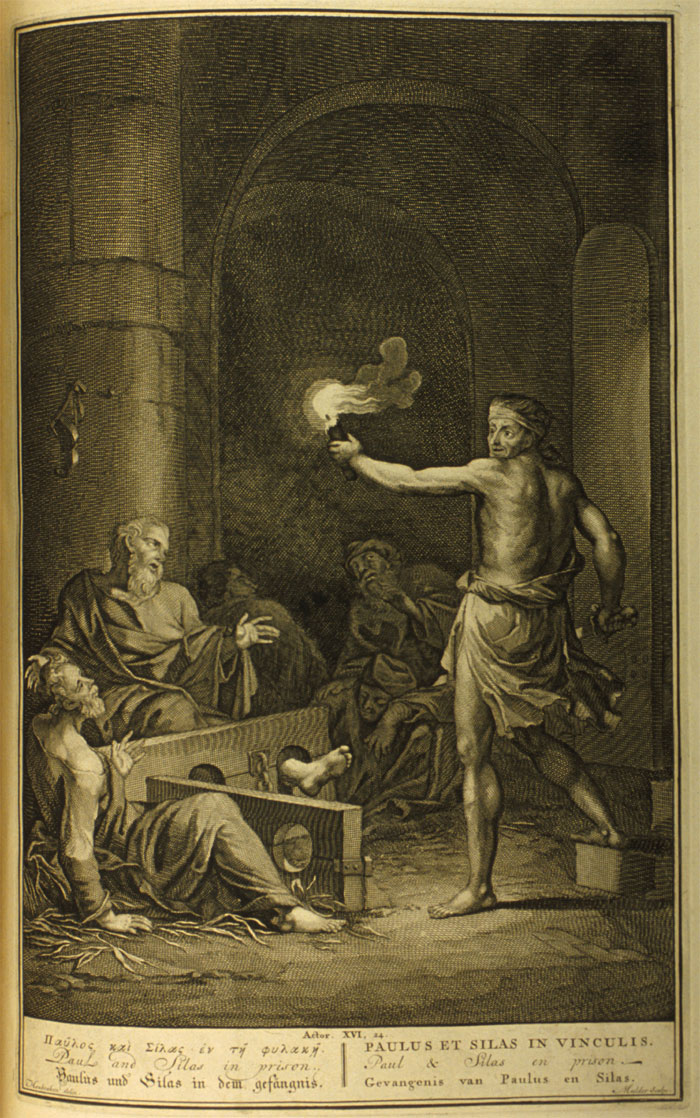
Figures de la Bible. Illustrated by Gerard Hoet, and others.
Published by P. de Hondt in The Hague (La Haye). 1728. Image courtesy History of Science Collections, University of Oklahoma Libraries

This past Sunday, we had part II of our "Instructed Eucharist." The interruptions this created in the flow of worship were so annoying to several other confidants that they related to me their relief that this experiment would probably not be replayed anytime soon. I found the interruptions had a negative effect on my worship in that I noticed a greater separation from God during the service. That feeling of separation was so profound that I could not blog about it properly until today.

In this Sunday's sermon (the 10:30 a.m. version), our rector avoided repeating his 8:00 a.m. error of injecting the politics of inclusion (read Arizona's immigration laws)into the homily, and instead focused on the reading from Acts 16:16-34.

Paul's motivation for ordering the demon out of the annoying prophetic slave girl was, according to this sermon, an act of love, motivated by pity from seeing the poor girl afflicted by a demon. I didn't hear it that way. Let's go back to the text,
One day, as we were going to the place of prayer, we met a slave-girl who had a spirit of divination and brought her owners a great deal of money by fortune-telling. While she followed Paul and us, she would cry out, ‘These men are slaves of the Most High God, who proclaim to you a way of salvation.’ She kept doing this for many days. But Paul, very much annoyed, turned and said to the spirit, ‘I order you in the name of Jesus Christ to come out of her.’ And it came out that very hour.

Paul's motivations are clearly stated, he was annoyed, otherwise this would have been a routine exorcism carried out in his first encounter with the girl. If this was primarily an act of love for the slave girl, wouldn't that have been documented? No, instead we hear that Paul was not just "annoyed," not just "very annoyed," but "very much annoyed." Any other motivations are purely speculative. After this imaginative start to the sermon, I could never get quite back on track and remained distracted. This distraction worsened as the "Instructed Eucharist" stumbled forward.

I did not get much out of the superficial "instructions" that interrupted the normal flow of the liturgy. I felt that this type of thing would be better done in a small group educational setting such as Sunday school, but shackled to my pew, I soldiered on.

My mind wandered to Paul and Silas as prisoners, their feet in stocks, singing hymns:

After they had given them a severe flogging, they threw them into prison and ordered the jailer to keep them securely. Following these instructions, he put them in the innermost cell and fastened their feet in the stocks. About midnight Paul and Silas were praying and singing hymns to God, and the prisoners were listening to them.

Note that they spent the night singing to God and not bemoaning their imprisonment. The next part of the reading from Acts really distracted me because it raised echoes of the earth shaking changes the Episcopal church has been bringing upon us:
Suddenly there was an earthquake, so violent that the foundations of the prison were shaken; and immediately all the doors were opened and everyone’s chains were unfastened. When the jailer woke up and saw the prison doors wide open, he drew his sword and was about to kill himself, since he supposed that the prisoners had escaped. But Paul shouted in a loud voice, ‘Do not harm yourself, for we are all here.’

This hit home not just because I was silently hoping the earth would shake and the Instructed Eucharist would end, but because I also saw an analogy with the remaining orthodox, those who did not flee to safety following the consecration of Gene Robinson in 2003 or following the consecration of Mary Glasspool on Mat 15. 2010. Flogged, put in stocks, and locked away, we have been offered a chance to flee to the new Anglican Church in North America or to other denominations (I greatly appreciate R. Sherman's offer of sanctuary in Missouri). Do we stay in prison out of ignorance, or is it for the love of God? Do we win converts by grumbling or crying out, or should we try to follow Paul and Silas' example by staying and making a joyful noise unto the Lord? What should we do when an opportunity for freedom suddenly appears? Is the Anglican schism like Paul's earthquake?

Other analogies kept popping up. The jailer's first impulse was to think that if the prisoners escaped, then he himself was doomed. This brings to mind the numerous lawsuits being pursued by the Episcopal church over departing parishes and dioceses. It is as though the Presiding bishop and her attorneys have adopted the role of jailer, and through her possession of the keys to church buildings she will discourage the prisoners from attempting a mass breakout. The desperate legal actions and maneuverings of the P.B. suggest, like the jailer, that there is an underlying fear of the consequences to herself if there are any further defections from T.E.C.

Paul's example also has me rethinking what I had considered to be a doomed "stayer" policy. The idea that the Episcopal church can be converted en-masse is ridiculous of course, but the power of faith that Paul and Silas displayed, a power that freed the jailer himself, is the kind of power that today might have effects beyond those that could ever be imagined by this distracted, grumbling blogger.

When freedom calls, perhaps we need to sit still, take stock, and praise God for his Word for that is who truly sets us free. With Him, we are free from fear of distraction and separation from God, and free from the finality of death. By not fleeing, but staying, unwavering in our hymns, oh, what a witness we could be.

Sunday, May 16, 2010

A Warning to the Writers of the RCL

I usually blog about the Sunday sermon, but this was really bugging me today.

This Sunday's readings highlight one of my pet peeves, and that is the problem of the "missing verses." We use the Revised Common Lectionary for the assigned readings and quite frequently this presents us pewsitters with an expurgated version of the Bible. What they did today to Revelation 22:12-14, 16-17, 20-12 sounds innocent enough,
12 ‘See, I am coming soon; my reward is with me, to repay according to everyone’s work.
13 I am the Alpha and the Omega, the first and the last, the beginning and the end.’
14 Blessed are those who wash their robes, so that they will have the right to the tree of life and may enter the city by the gates.

16 ‘It is I, Jesus, who sent my angel to you with this testimony for the churches. I am the root and the descendant of David, the bright morning star.’
17The Spirit and the bride say, ‘Come.’
And let everyone who hears say, ‘Come.’
And let everyone who is thirsty come.
Let anyone who wishes take the water of life as a gift.

20 The one who testifies to these things says, ‘Surely I am coming soon.’
Amen. Come, Lord Jesus!
21 The grace of the Lord Jesus be with all the saints. Amen


I wonder if they just wanted to make things sound pretty by cutting the verses of warning,
v. 15
"Outside are the dogs and sorcerers and fornicators and murderers and idolaters, and everyone who loves and practises falsehood."

We sure should have heard that one the day after the consecration of Mary Glasspool in Los Angeles. I know, that verse is exclusionist (bad), and we are living in the age of theological pluralism (everybody gets in), and rationalism (there is no absolute truth so there is no absolute falsehood), but at times like this, I am beyond suspicious of the motives of the composers of the RCL.

And also left out was the part that the RCL really, really should not have tried to expurgate, vs. 18-19
"I warn everyone who hears the words of the prophecy of this book: if anyone adds to them, God will add to that person the plagues described in this book; if anyone takes away from the words of the book of this prophecy, God will take away that person’s share in the tree of life and in the holy city, which are described in this book."

Uh oh...

Wednesday, May 12, 2010

The Spider's Web

What is your first reaction when you walk into a spider's web? Mine is to step back and brush it out of my hair, then peel it off my fingers, and the check for the spider. Fortunately, I am large enough to not become trapped in most webs. Some webs are so big that it is impossible to brush them off. This picture of Moscow from space is one example:


Photo from Space.com

Spiders' webs are among God's most amazing works, but the web is both beautiful and dangerous. The cities of man, along with their rulers, can appear beautiful when seen in the right light, but make one wrong turn at the wrong time, and you could wind up like the spider's prey. This juxtaposition of beauty and danger in the same image reminds me of how commonly this type of thing occurs in life. Think of the dangerous smile of the politician, think of the reassurance of the "nanny state" with its promises of social security, universal health care, etc. I was reading the book of Proverbs last week and recall the warnings of the allure of the seductress,
Proverbs 5:1-13
My son, to my wisdom be attentive, to my knowledge incline your ear,
That discretion may watch over you, and understanding may guard you.
The lips of an adulteress drip with honey, and her mouth is smoother than oil;
But in the end she is as bitter as wormwood, as sharp as a two-edged sword.
Her feet go down to death, to the nether world her steps attain;
Lest you see before you the road to life, her paths will ramble, you know not where.
So now, O children, listen to me, go not astray from the words of my mouth.
Keep your way far from her, approach not the door of her house, Lest you give your honor to others, and your years to a merciless one;
Lest strangers have their fill of your wealth, your hard-won earnings go to an alien's house;
And you groan in the end, when your flesh and your body are consumed;
And you say, "Oh, why did I hate instruction, and my heart spurn reproof!
Why did I not listen to the voice of my teachers, nor to my instructors incline my ear!

There are lessons there for our nation. Are there any other associations that come to mind?

I, for one, will be thinking about this reading as the images of the consecration of Mary Glasspool float around the world wide web this coming weekend. I am sure those images will appear beautiful and attractive to some, but to this wary fly on the wall, the awareness of the dangers of the sticky web that is being spun in the Episcopal church should keep me safe. The Proverb warns us to keep our distance. In addition, we need to think more about the Proverb's warning about our hard-won earnings going to an alien's house in light of this new thread in the spider's web.