Sunday, March 31, 2013

Straw Men and Cheesus Heads Meet the Resurrected Lord

h/t to the Ugley Vicar for the following quote attributed to the Revd Dr Giles Fraser, priest-in-charge at St Mary's Newington in south London.
"for the worst sort of Cheesus-loving evangelicals, the cross of Good Friday is actually celebrated as a moment of triumph. This is theologically illiterate."
John Richardson+ dissects this very well for us in his post at the Ugley Vicar. I would like to add that when I read through Giles Fraser's original article at The Guardian, that I got the uncomfortable feeling that Fraser had constructed a straw man version of a "Cheesus-loving evangelical" which he could then turn into an easily defeated enemy which is not exactly the way of the theologically literate.

For example,
   "After a while, if you say a word enough, over and over again, it loses its meaning. It even begins to sound a little different. Jesus morphs into Cheesus – the es getting steadily elongated. Those who talk about Cheesus do so with a creepy sort of chummyiness. This is what evangelicals call 'a personal relationship', by which they mean that Cheesus has become their boyfriend or best mate. 
And when such people speak of Cheesus they have to wear that sickly smile too. It's that I-know-something-you-don't smile. Patronising, superior and faux caring all at the same time. And if you disagree with them they will pray for you. It makes you want to bang your head against a brick wall."
 

Now that is a pretty cheesey picture, but it is a fabrication, a straw man. The fact that it was even published makes me want to bang my head against the wall.

Yes Jesus' suffering on the cross was horrible, but the paradox of the cross is that it was only the appearance of the triumph of evil. On the cross, and through the grave, God is in glory crowned. The understanding that the cross represents the triumph of God over Sin, death, and evil would have to wait until the third day or later after we humans had a chance to think about what it was that actually happened as well as its meaning for the world. I guess that understanding might be the result of "Cheesus-loving theology." Would Giles Fraser consider that "creepy?"  

Count me in with Fraser's theologically illiterate.
"But we preach Christ crucified, unto the Jews a stumbling block, and unto the Greeks foolishness;
But unto them which are called, both Jews and Greeks, Christ the power of God, and the wisdom of God.
Because the foolishness of God is wiser than men; and the weakness of God is stronger than men." 1 Corinthians 1:23-25 (KJV)
So, all you Cheesus heads out there, smile and say a prayer through the gaps in your teeth for your old chum Giles Fraser. If you see him, give him a big fat hug and tell him, "No cross, no crown!"
Or whisper in his ear, "Philippians 2:8-11."
"And being found in fashion as a man, he humbled himself, and became obedient unto death, even the death of the cross.
Wherefore God also hath highly exalted him, and given him a name which is above every name:
That at the name of Jesus every knee should bow, of things in heaven, and things in earth, and things under the earth;
And that every tongue should confess that Jesus Christ is Lord, to the glory of God the Father." Philippians 2:8-11 (KJV)

So sock it to the literate today with a few triumphant Hallelujahs and emphasize the "YAHs." I know it might bug them, but wish them a happy Easter too.

Wednesday, March 27, 2013

A Small Problem With the Denomination Selector

After learning that the Episcopal Diocese of Virginia was hosting retired Bishop John Shelby Spong on Good Friday, and knowing that Spong denies the physical resurrection of Christ (see "What's wrong with John Shelby Spong"), I had to wonder, "What kind of church is this that puts heretics in the pulpit on Good Friday?"

My answer, "Yikes, that's my denomination!"

If that is enough to make you want to run for the hills, here is a little quiz for you that purports to give your feet a little direction:
Free Denomination Selector

I took the quiz after seeing the link on Churchmouse Campanologist , and guess what I found.

What may come as a surprise to some, my top denomination came out to be Episcopal/Anglican at 100%. Does this mean I am stuck with John Shelby Spong? One must understand that this quiz was developed in 2001 before +VGR, before SSB's, before the departure of ACNA, DSC, etc., but not before the ministry of Bishop Spong. So I think the problem for the denomination seeker using the "Free Denomination Selector" is that there are alot of Episcopal churches out there that do not believe in the physical resurrection of Jesus, do not believe in a literal Heaven and Hell, do not believe that salvation can only be found through Jesus Christ, etc. I could go on and on with my responses that are in conflict with a church that would give Bishop Spong pulpit time. If this on-line test had guided me to St. Paul’s Episcopal Church in Richmond, Virginia this Friday, I would have felt like I did when my college room-mate once talked me into going on a certain blind date.

How might a seeker who does believe in the physical resurrection and does not believe in SSB's find an appropriate Episcopal/Anglican church? I am sure that not all Southern Baptist churches are the same either, and someone (in a small southern city like ours) who looks like a good match with the Southern Baptists according to the Denomination Selector might face a bewildering array of congregations from which to chose.

So here's a suggestion to all you entrepreneurial types out there, why not come up with a church matching web site like the popular dating web sites? I think such a site would give individual pastors, priests, churches, sects, cults, covens, a chance to input their unique set of quirks, passions, beliefs, non-beliefs, heresies, or whatever, into an algorithm that will match potential visitors to a particular church in their geographical area. This would reduce the amount of time wasted on church shopping expeditions as well as reducing the time clergy would have to spend explaining their beliefs and practices to newcomers.

In case you are interested, here are the rest of my rankings.

2) Methodist/Wesleyan Church (98%)
3) Evangelical Lutheran Church (90%)
4) Lutheran Church-Missouri Synod (90%)
5) Mennonite Brethren (85%)
6) Assemblies of God (78%)
7) Church of Christ (78%)
8) Free Will Baptist (78%)
9) Orthodox Quakerism (78%)
10) Seventh-Day Adventist (78%)
11) Southern Baptist (70%)
12) International Church of Christ (65%)
13) Presbyterian Church USA (65%)
14) Presbyterian Church in America/Orthodox Presbyterian Church (65%)
15) Reformed Churches (65%)
16) Eastern Orthodox Church (63%)
17) Reformed Baptist (58%)
18) Roman Catholic Church (58%)
19) United Pentecostal Church (58%)
20) Mormonism (38%)
21) Liberal Quakerism (28%)
22) Jehovah's Witness (18%)
23) Unity Church (8%)
24) Unitarian Universalism (0%)

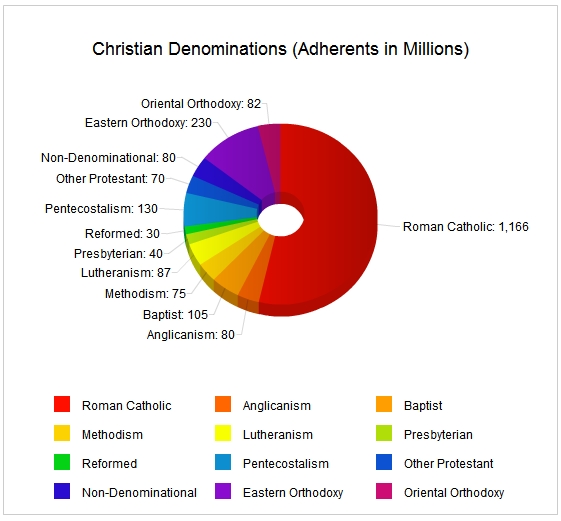
To give you some idea of how far under the radar we Anglicans are, here is the "Denompie":

From http://christianityinview.com/

Even the Oriental Orthodox have a bigger piece of the pie than Anglicans. 

Just imagine the size of the slice that might be occupied by TEc alone (which is where it will find itself if it continues in its walk apart from the historic Anglican Communion).

I wonder if that slice comes with a graham cracker crust?  

That would look pretty crumby huh?
  

Sunday, March 24, 2013

Spring Rain, Spring Tears, The Promise of Lent's End

Today's Palm Sunday service was a painful one. The weather was rainy, cold, and more like an Ash Wednesday than a Palm Sunday in the South. Prior to the reading of the Passion narrative and the subsequent gloomy organ solo, today's short homily brought back too many memories of recent deaths and too many graphic details of hospital visits and funerals while not offering enough hope for the Resurrection to offset the despair.

Holy Week always reminds me of the bitter and the sweet, the loss and the victory, and I have to look back at how I have come through the dark, gloomy times of my life in order to better reflect on the facts that there will always be a tomorrow, the rain of tears and the floods of sorrows will go away, and the Sun will shine on a new day.

As I finish these cold, rainy, sometimes tearful days of Lent, and make myself look forward to Easter's warmth of the Son, I pause to reflect on earlier Lents, Springtimes of my youth, rainy days, and the fact that no matter if I fell short of my goals during Lent, or no matter how dark or dismal the personal circumstances may have seemed, in the long run God found a way to rescue, restore, and lift me up to be high and dry, together with Him.

Today's gloom and doom brought back a flood of memories for me. One of these I share below. I drove by the place pictured below just before Lent began this year, and I saw that the place was gutted. Much needed renovations were scheduled. Its old broken skeleton will be reborn. The old memories survive, both the good and the bad, no earthly renovations can remove those, but I can thank God that he keeps them in their rightful place and only lets them out on days like this.

(Images from my shoebox)

Spring Rain

"I thought I had forgotten,
But it all came back again
To-night with the first spring thunder
In a rush of rain.
I remembered a darkened doorway
Where we stood while the storm swept by,


Thunder gripping the earth
And lightning scrawled on the sky.
The passing motor busses swayed,
For the street was a river of rain,


Lashed into little golden waves
In the lamp light's stain.
With the wild spring rain and thunder
My heart was wild and gay;
Your eyes said more to me that night
Than your lips would ever say. . . .
I thought I had forgotten,
But it all came back again
To-night with the first spring thunder
In a rush of rain."
Love Songs
By Sara Teasdale 1884-1933

This time of year can give us the both the loveliest and the nastiest weather, beautiful winter scenes, false Springs, and seasonal depression too. Today we got a big dose of nasty. The old saying goes, "April showers bring May flowers," except around here we seem to get our rain in March and the flowers in April. I guess this is one of those years where we get tears raining down too.

Let the promise of Easter carry us through the next week because wonderful things are coming that will dry every one of those tears.

Come Lord Jesus...


Wednesday, March 20, 2013

The Unintended Benefits of the Welfare State

What benefits am I talking about? The "Jihad Seekers Allowance" for one. This was the reported boasting of a Muslim moocher preacher in the U.K. He believes that using the welfare system to fund jihad is perfectly justifiable because, in his interpretation of Islam, it is okay to take money from non-believers. Of course it is also perfectly fine to turn around and use that money to destroy those stupid generous non-believers. From the Telegraph: See the story here.

The rest of us hard working 9-5'ers need to get on the dole too and start feeding off the remaining few idiots who slave away to support the real workers, those engaged in jihad.

From Savoir ou se Faire Avoir
 

Sunday, March 17, 2013

Lenten Pastoral Letter From Bishop Waldo

In place of a sermon today, we were read Bishop Waldo's Lenten Pastoral Letter which I reproduce below. It is not altogether uncommon for clerics to present themselves as completely respectable churchmen in their letters and sermons. Their actions however, such as when they push forward the use of a rite for same sex blessings, betray a deeper flawed theology which they hope to eventually pass on to their unsuspecting sheep. I regard our bishop's Lenten Pastoral letter as a sucker punch softening us up for the knockout punch later. Another way of looking at it is through the lens of history. In the past, there have been teachers who, thanks to their ability to sound orthodox, or through their convincing speech (think Marcion), were able to gather large followings, and because people were so easily taken in by the parts that sounded good, it took years to determine that parts of the teachings were actually heretical.

We are no less vulnerable today.

Until our bishop repents of his deviation from the Apostolic faith and the Anglican Communion (as evidenced by his stated desire to see same sex blessings take place in this diocese), I will regard his words below as perhaps a sweet syrup served up to cover the bitter scroll which we will be forced to swallow in the future.

"Pastoral Letter for Lent 2013

Brothers and Sisters in Christ,

Many years ago, as a young, newly-married musician in Boston, I commuted 70 miles three times per week into Cambridge, Massachusetts, from our home in the woods of southwestern New Hampshire. The long drives home, often late at night, gave me the chance to listen to tapes of lectures and music. One was a tape of Frederick Buechner giving the talks that would become his autobiographical book, Now and Then: A Memoir of Vocation, published in 1983.

One story he tells in the book is of a period in his life when he taught religion—at Exeter Academy, as I remember it. Among his classes was one on world religions. He had asked his students to imagine two statues—one of the Buddha in prayer, the other of Jesus in prayer, both with eyes closed. After some discussion on prayer, he clarified the key difference between the intentions represented by these images. The Buddha’s eyes were closed to shut out the world; Jesus’ eyes were closed around the world, embracing it in its totality.

The contrast between these two images and the implications for my discipleship were immediately apparent to me. If Jesus’ eyes, closed in their embrace of the world, are eyes of compassion and signs of God’s infinite love for the world, my own discipleship would have to reflect that in every relationship—both public and private.

Such depth of compassion remains a challenge for me. Therefore, when I take on a Lenten discipline, I seek something that will initiate a change deep within me—to see Christ more clearly, love him more dearly, and especially to follow him more nearly. When I hold this intention in the light of Christ’s all-embracing compassion, I return again and again to John 3:16, that “God so loved the world that he gave his only Son, so that everyone who believes in him may not perish, but may have eternal life.” Because of God’s love for me and my love for God, I am called to open the doors of my heart to others. This is as true when I find myself in the midst of dissonance and disagreement in the Church as it is when I randomly encounter someone whose presence or situation dares me to open my heart and be the disciple God calls me to be.

In Jesus’ Sermon on the Mount in Matthew and his Sermon on the Plain in Luke, Jesus says that we are to “Love your enemies” and, in Luke (6:27-28), “do good to those who hate you, bless those who curse you, pray for those who abuse you.” In Matthew (5:44-45), he says, “Love your enemies and pray for those who persecute you, so that you may be children of your Father in heaven.” It is hard to think of anything more difficult for us to do than to embrace a love like this. Yet Matthew concludes this saying with, “Be perfect, therefore, as your heavenly Father is perfect.” And Luke says, “Be merciful, just as your Father is merciful.”
Compassion and mercy are at the very heart of perfecting our life in Christ as mature disciples.

We often think we have to get our beliefs logically ordered and discern who is worthy of Christian love before we can really give ourselves to compassion. Jesus must have anticipated this temptation, for, in Luke, his injunction against judging others follows immediately on his call to be merciful. In Matthew, it follows only a chapter after his call to be perfect.

Perhaps our ideal Lenten discipline is to be attentive in those moments when our eyes are shutting out the world—especially if we shut out the world in anger, hatred or despair. And then to open our eyes and the doors of our hearts to learn to love again, even as Christ loved us and gave himself for us, an offering and sacrifice to God.

May your Lent be blessed with growth in the power of the Holy Spirit beyond anything that you can ask or imagine.

In Christ,

The Rt. Rev. W. Andrew Waldo
VIII Bishop
The Episcopal Diocese of Upper South Carolina"
 

Wednesday, March 13, 2013

Universalism is Alive and Well, Guess Where...


Every now and then I peek in and see what viruses are spreading in the church by following up on a blog post from one of the bloggers in my "potentially harmful" column. When "All Will Be Saved" popped up, I made a quick guess as to what this particular Episcopal priest was going to say, and I then went to his site to see if he delivered what I expected. He did...
"Paul's teaching, his theology is a doctrine of universal salvation.  The wise will start living "in Christ" now, and enjoy the gifts that are ours immediately.  The foolish merely postpone what is humanity's universal gift.  It's all because of Christ.  His obedience and faithfulness frees all.  Forever. P.S.  The Baptists are wrong.  Thanks be to God!"
All the more reason to be foolish and stay home on Sunday mornings I guess. I have often heard the "P.S." that this Episcopal priest proclaims, "The Baptists are wrong. Thanks be to God." This sort of arrogant self-righteousness has infected the denomination for decades. I would beg him and any of us who hold such beliefs to confess and repent of our own sins and not to cast stones on the Baptists.

While I can see how one might come to think that Paul believed that ultimately all will be saved from a reading of verses like,
"For the unbelieving husband is sanctified by the wife, and the unbelieving wife is sanctified by the husband: else were your children unclean; but now are they holy." 1 Corinthians 6:14 (KJV)
(I wonder if that verse would be helpful to those yoked to an unbelieving priest, bishop, or denomination)

 I still suspect the rector may have been reading a few too many Universalist blog posts for his own good. These tend to use Paul in similar ways to back up their claims. Here is an opposing view from Bob Faulkner for your perusal (link to EzineArticles post).

"But what of those who have never heard? The Universalist truly wants to upstage the Bible believer here with what he believes is the obvious answer to this centuries-old enigma: 'Why, they will all be saved. This is a non-issue now.'
Believing that all men will be saved from God's judgment eventually, certainly takes the teeth out of the Great Commission, and the entire missions history of the church of Jesus. Something in us wants to believe it, but it doesn't ring true when measured by other Biblical facts.
Without going further into that whole very difficult problem, let me just share Paul's short answer, here in Romans 2:12:
"Damnation will come to those who sinned because they had no law, and it will come equally to those who had the law and sinned against it. Sin is sin. God's law is written in the hearts of even the Gentiles. They know what is right and wrong. God will judge every thought, every motive, of every man by the Man Christ Jesus.'
Who will be able to stand in that day?
Paul says, in essence, no one. Righteousness is not obtainable by human effort. Only those who cling to the righteousness of Christ will be saved.
If there is a universalism in God's world, it is universal damnation. '... all the world may become guilty before God' (3:19).

I would advise our universalist Episcopal priest, who is probably not at all interested in listening to Bob Faulkner, to lend an ear to J. C. Ryle (1816-1900) the first Anglican bishop of Liverpool,

"Disbelieve hell, and you unscrew, unsettle, and unpin everything in Scripture."
and
"The saddest road to hell is the one that runs under the pulpit, past the Bible, and through the middle of warnings and invitations."
and
"The whole extent of hell, the present suffering, the bitter recollection of the past, the hopeless prospect of the future, will never be thoroughly known except by those who go there."
or perhaps he might heed the words of Paul,

"Know ye not that the unrighteous shall not inherit the kingdom of God? Be not deceived: neither fornicators, nor idolaters, nor adulterers, nor effeminate, nor abusers of themselves with mankind,
Nor thieves, nor covetous, nor drunkards, nor revilers, nor extortioners, shall inherit the kingdom of God." 1 Corinthians 6:9-10 (KJV)
and

"If any man love not the Lord Jesus Christ, let him be Anathema Maranatha."
1 Corinthians 16:22 (KJV)
or maybe even the words of Jesus himself,
"There was a certain rich man, which was clothed in purple and fine linen, and fared sumptuously every day:
 And there was a certain beggar named Lazarus, which was laid at his gate, full of sores,
 And desiring to be fed with the crumbs which fell from the rich man's table: moreover the dogs came and licked his sores.
 And it came to pass, that the beggar died, and was carried by the angels into Abraham's bosom: the rich man also died, and was buried;
 And in hell he lift up his eyes, being in torments, and seeth Abraham afar off, and Lazarus in his bosom.
 And he cried and said, Father Abraham, have mercy on me, and send Lazarus, that he may dip the tip of his finger in water, and cool my tongue; for I am tormented in this flame.
But Abraham said, Son, remember that thou in thy lifetime receivedst thy good things, and likewise Lazarus evil things: but now he is comforted, and thou art tormented.

And beside all this, between us and you there is a great gulf fixed: so that they which would pass from hence to you cannot; neither can they pass to us, that would come from thence.

Then he said, I pray thee therefore, father, that thou wouldest send him to my father's house:
For I have five brethren; that he may testify unto them, lest they also come into this place of torment.
Abraham saith unto him, They have Moses and the prophets; let them hear them.
And he said, Nay, father Abraham: but if one went unto them from the dead, they will repent.
And he said unto him, If they hear not Moses and the prophets, neither will they be persuaded, though one rose from the dead."
Luke 16:19-31 (KJV)
and


"Enter by the narrow gate. For the gate is wide and the way is easy that leads to destruction,
and those who enter by it are many. For the gate is narrow and the way is hard that
leads to life, and those who find it are few."
Matthew 7:13-14, (ESV)


I have since moved the Episcopal priest's blog to my "TOO WEIRD FOR WORDS (ENTER AT YOUR OWN RISK)" list on the sidebar.

The saddest thing is that 400 souls might hear this confusing teaching on any given Sunday in his church.

I said "confusing teaching" because those same people might, if they are paying attention at all, hear and speak words that are quite contrary to their priest's ramblings, words from their own Prayer Books.

A few years ago, Bryan Owen+ commented on prayers found in the 1979 Book of Common Prayer (BCP) that speak in ways that appear contrary to the claims of Episcouniversalist priests. Here are a couple of the examples Bryan cited,

Suffrage B in Evening Prayer Rite II: “That we may depart this life in your faith and fear, and not be condemned before the great judgment seat of Christ” (BCP, p. 122). This petition not only affirms a final judgment, but also leaves open the possibility of condemnation at that judgment.
The Great Litany
1. “Spare us … from everlasting damnation” (BCP, p. 148). This suggests that everlasting damnation is possible, else why petition God to be spared from it?
2. “That it may please thee to grant that … we may attain to thy heavenly kingdom” (BCP, p. 152). This suggests that it’s possible we may not attain it.

Spouting universalistic Episcobabble is contrary to the church's doctrine if that doctrine can be inferred from what is found in the current Prayer Book.

We need to watch and see if in the next Book of Common Prayer those prayers are revised, and we need to pay close attention to exactly who is on that future Prayer Book task force.


Sunday, March 10, 2013

Lost Parables, Lost Sheep, Lost Coins, Lost Sons, Churches Lost to the Gospel of Radical Affirmation

Today's Gospel reading focused on the parable of the prodigal son found in Luke 15, and due to the capricious way the lectionary in our church gets sliced and diced, the parables of the lost sheep and lost coin were themselves lost (today's reading was Luke 15:1-3,11-32 which omitted verses 4-10).

So today, I am going to look at the things we might have lost.

Then drew near unto him all the publicans and sinners for to hear him.
And the Pharisees and scribes murmured, saying, This man receiveth sinners, and eateth with them.
And he spake this parable unto them, saying,
What man of you, having an hundred sheep, if he lose one of them, doth not leave the ninety and nine in the wilderness, and go after that which is lost, until he find it?
And when he hath found it, he layeth it on his shoulders, rejoicing.
And when he cometh home, he calleth together his friends and neighbours, saying unto them, Rejoice with me; for I have found my sheep which was lost.
I say unto you, that likewise joy shall be in heaven over one sinner that repenteth, more than over ninety and nine just persons, which need no repentance.
Either what woman having ten pieces of silver, if she lose one piece, doth not light a candle, and sweep the house, and seek diligently till she find it?
And when she hath found it, she calleth her friends and her neighbours together, saying, Rejoice with me; for I have found the piece which I had lost.
Likewise, I say unto you, there is joy in the presence of the angels of God over one sinner that repenteth. Luke 15:4-10 (KJV)

The beginning of Luke 15 demonstrates how Jesus associated with sinners. Jesus' ministry to those in greatest need of Him might have been mistaken for acceptance by the Pharisees who took the chance to be critical of Him. The subsequent parable of the lost sheep, and the parable of the lost coin reveal the judgement of "sinner" that our Lord was ready to lay upon those to whom he was reaching out.
"Likewise, I say unto you, there is joy in the presence of the angels of God over one sinner that repenteth."
The next parable, the parable of the prodigal son follows up on the theme of joy over the return of the repentant sinner as well as supplementing and reinforcing the message of the previous parables.

The parable of the prodigal son which we heard today is powerful enough to stand on its own, but I think the other two parables should be considered at the same time. They introduce the role of an outside agent who tracks down the lost and brings them back, rather than waiting for the sinner to discover this the hard way, and this seeking out of the lost is something that we are called to do in our own ministries. Now, it can be difficult to find the lost if you have been fed a steady diet of pluralism or universalism in your church, and if you believe that all are saved no matter whether they believe in Jesus as Lord or not.

Then as now, unfortunately, there are some who have set themselves apart from the Lord. They are the focus of Jesus' attention in today's lessons. Jesus' dining with sinners is often termed "radical inclusivity." This term has been misused as we shall see in a second. His ministry to these people was aimed at bringing sinners, those whom the Pharisees would exclude, to repentance and back into fellowship. The meals were not free, and the grace was not cheap.

It has been said that the Episcopal church is a "welcoming" church, and is a church that lives into a gospel of radical inclusion when it reaches out to those who identify themselves as LGBTQ. The message boils down to this:
"Come as you are, and stay as you are."
"We are not here to judge."
"When we dine with you it is to learn from you and not you from us."
"We will be changed."
"You only thought you were lost sheep."
"It was us who labelled you as lost."
When the church elected its first openly gay, divorced, non-celibate male bishop in the form of Gene Robinson, the church celebrated its radical inclusiveness. We were supposed to learn a great lesson through this prophetic action, but instead, what was being taught to the people was a "gospel of radical affirmation" (I just googled that and stumped Google! I had to put it into the title of this post because of that). Radical affirmation makes the work of finding the lost a whole lot easier because this removes all the barriers to "relationship" that might show up if a modern day good shepherd were to make the mistake of telling a lost sheep that it was going somewhere dangerous or doing something harmful.

Modern radical welcoming/inclusivity/affirmation is a far different thing from what Jesus was up to. To illustrate this I made up a modern parable a while back satirizing the false gospel of radical inclusion/affirmation. I called it "Wallowing in the Mire."

You have in your flock many sheep. When you discover one missing, which one of you does not go out in search of the missing sheep? Which one of you, when you find that the lost sheep has discovered its authentic self as a pig, and is happiest when wallowing in mud, does not say, "Let me bring the rest of the flock here so that they too may wallow in the mud"? And when he has done so, he calls his neighbors, saying to them, "Rejoice with me, for I have found that sheep prefer to be pigs, and are happiest when they can wallow in the mire. Join us." Just so, that which was once considered sinful may now be considered blessed. (UP 7:11/12a)
 

So, is your church seeking the lost? Does your church pray for repentance and change?

Or is your church unable to pin the lost label on anyone?

Or is your church lost and in need of the Seeker?

If it is the latter two, pray, listen to your Judge and Advocate, repent, and be returned.