Wednesday, May 19, 2010

Pewsters in the Stocks


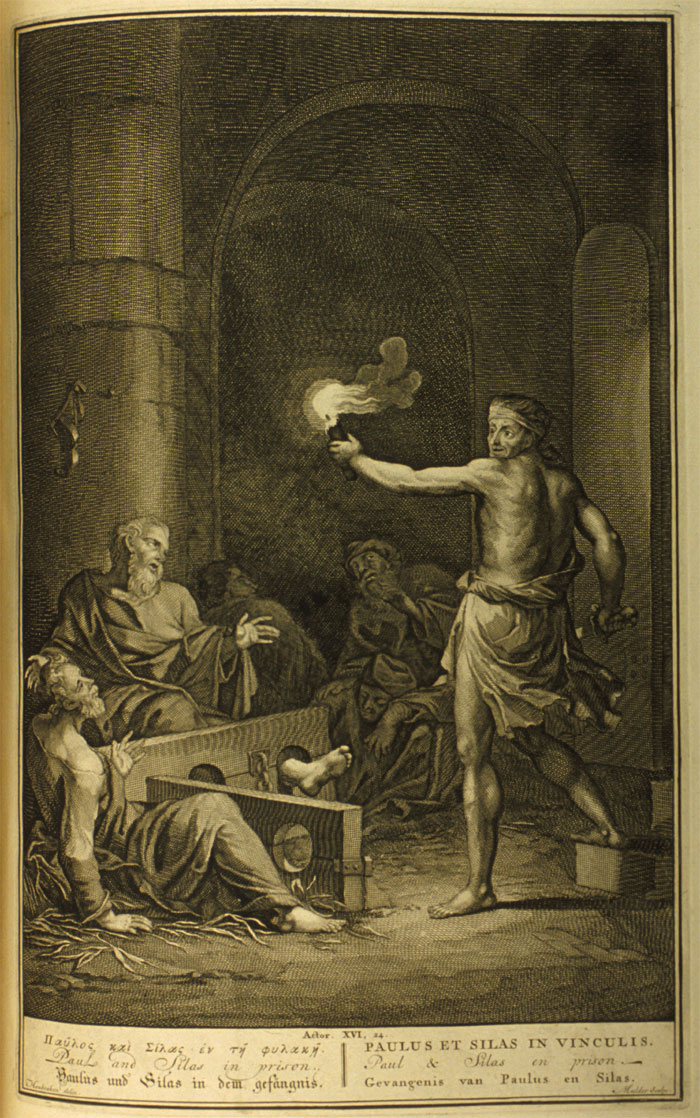
Figures de la Bible. Illustrated by Gerard Hoet, and others.
Published by P. de Hondt in The Hague (La Haye). 1728. Image courtesy History of Science Collections, University of Oklahoma Libraries

This past Sunday, we had part II of our "Instructed Eucharist." The interruptions this created in the flow of worship were so annoying to several other confidants that they related to me their relief that this experiment would probably not be replayed anytime soon. I found the interruptions had a negative effect on my worship in that I noticed a greater separation from God during the service. That feeling of separation was so profound that I could not blog about it properly until today.

In this Sunday's sermon (the 10:30 a.m. version), our rector avoided repeating his 8:00 a.m. error of injecting the politics of inclusion (read Arizona's immigration laws)into the homily, and instead focused on the reading from Acts 16:16-34.

Paul's motivation for ordering the demon out of the annoying prophetic slave girl was, according to this sermon, an act of love, motivated by pity from seeing the poor girl afflicted by a demon. I didn't hear it that way. Let's go back to the text,
One day, as we were going to the place of prayer, we met a slave-girl who had a spirit of divination and brought her owners a great deal of money by fortune-telling. While she followed Paul and us, she would cry out, ‘These men are slaves of the Most High God, who proclaim to you a way of salvation.’ She kept doing this for many days. But Paul, very much annoyed, turned and said to the spirit, ‘I order you in the name of Jesus Christ to come out of her.’ And it came out that very hour.

Paul's motivations are clearly stated, he was annoyed, otherwise this would have been a routine exorcism carried out in his first encounter with the girl. If this was primarily an act of love for the slave girl, wouldn't that have been documented? No, instead we hear that Paul was not just "annoyed," not just "very annoyed," but "very much annoyed." Any other motivations are purely speculative. After this imaginative start to the sermon, I could never get quite back on track and remained distracted. This distraction worsened as the "Instructed Eucharist" stumbled forward.

I did not get much out of the superficial "instructions" that interrupted the normal flow of the liturgy. I felt that this type of thing would be better done in a small group educational setting such as Sunday school, but shackled to my pew, I soldiered on.

My mind wandered to Paul and Silas as prisoners, their feet in stocks, singing hymns:

After they had given them a severe flogging, they threw them into prison and ordered the jailer to keep them securely. Following these instructions, he put them in the innermost cell and fastened their feet in the stocks. About midnight Paul and Silas were praying and singing hymns to God, and the prisoners were listening to them.

Note that they spent the night singing to God and not bemoaning their imprisonment. The next part of the reading from Acts really distracted me because it raised echoes of the earth shaking changes the Episcopal church has been bringing upon us:
Suddenly there was an earthquake, so violent that the foundations of the prison were shaken; and immediately all the doors were opened and everyone’s chains were unfastened. When the jailer woke up and saw the prison doors wide open, he drew his sword and was about to kill himself, since he supposed that the prisoners had escaped. But Paul shouted in a loud voice, ‘Do not harm yourself, for we are all here.’

This hit home not just because I was silently hoping the earth would shake and the Instructed Eucharist would end, but because I also saw an analogy with the remaining orthodox, those who did not flee to safety following the consecration of Gene Robinson in 2003 or following the consecration of Mary Glasspool on Mat 15. 2010. Flogged, put in stocks, and locked away, we have been offered a chance to flee to the new Anglican Church in North America or to other denominations (I greatly appreciate R. Sherman's offer of sanctuary in Missouri). Do we stay in prison out of ignorance, or is it for the love of God? Do we win converts by grumbling or crying out, or should we try to follow Paul and Silas' example by staying and making a joyful noise unto the Lord? What should we do when an opportunity for freedom suddenly appears? Is the Anglican schism like Paul's earthquake?

Other analogies kept popping up. The jailer's first impulse was to think that if the prisoners escaped, then he himself was doomed. This brings to mind the numerous lawsuits being pursued by the Episcopal church over departing parishes and dioceses. It is as though the Presiding bishop and her attorneys have adopted the role of jailer, and through her possession of the keys to church buildings she will discourage the prisoners from attempting a mass breakout. The desperate legal actions and maneuverings of the P.B. suggest, like the jailer, that there is an underlying fear of the consequences to herself if there are any further defections from T.E.C.

Paul's example also has me rethinking what I had considered to be a doomed "stayer" policy. The idea that the Episcopal church can be converted en-masse is ridiculous of course, but the power of faith that Paul and Silas displayed, a power that freed the jailer himself, is the kind of power that today might have effects beyond those that could ever be imagined by this distracted, grumbling blogger.

When freedom calls, perhaps we need to sit still, take stock, and praise God for his Word for that is who truly sets us free. With Him, we are free from fear of distraction and separation from God, and free from the finality of death. By not fleeing, but staying, unwavering in our hymns, oh, what a witness we could be.

Sunday, May 16, 2010

A Warning to the Writers of the RCL

I usually blog about the Sunday sermon, but this was really bugging me today.

This Sunday's readings highlight one of my pet peeves, and that is the problem of the "missing verses." We use the Revised Common Lectionary for the assigned readings and quite frequently this presents us pewsitters with an expurgated version of the Bible. What they did today to Revelation 22:12-14, 16-17, 20-12 sounds innocent enough,
12 ‘See, I am coming soon; my reward is with me, to repay according to everyone’s work.
13 I am the Alpha and the Omega, the first and the last, the beginning and the end.’
14 Blessed are those who wash their robes, so that they will have the right to the tree of life and may enter the city by the gates.

16 ‘It is I, Jesus, who sent my angel to you with this testimony for the churches. I am the root and the descendant of David, the bright morning star.’
17The Spirit and the bride say, ‘Come.’
And let everyone who hears say, ‘Come.’
And let everyone who is thirsty come.
Let anyone who wishes take the water of life as a gift.

20 The one who testifies to these things says, ‘Surely I am coming soon.’
Amen. Come, Lord Jesus!
21 The grace of the Lord Jesus be with all the saints. Amen


I wonder if they just wanted to make things sound pretty by cutting the verses of warning,
v. 15
"Outside are the dogs and sorcerers and fornicators and murderers and idolaters, and everyone who loves and practises falsehood."

We sure should have heard that one the day after the consecration of Mary Glasspool in Los Angeles. I know, that verse is exclusionist (bad), and we are living in the age of theological pluralism (everybody gets in), and rationalism (there is no absolute truth so there is no absolute falsehood), but at times like this, I am beyond suspicious of the motives of the composers of the RCL.

And also left out was the part that the RCL really, really should not have tried to expurgate, vs. 18-19
"I warn everyone who hears the words of the prophecy of this book: if anyone adds to them, God will add to that person the plagues described in this book; if anyone takes away from the words of the book of this prophecy, God will take away that person’s share in the tree of life and in the holy city, which are described in this book."

Uh oh...

Wednesday, May 12, 2010

The Spider's Web

What is your first reaction when you walk into a spider's web? Mine is to step back and brush it out of my hair, then peel it off my fingers, and the check for the spider. Fortunately, I am large enough to not become trapped in most webs. Some webs are so big that it is impossible to brush them off. This picture of Moscow from space is one example:


Photo from Space.com

Spiders' webs are among God's most amazing works, but the web is both beautiful and dangerous. The cities of man, along with their rulers, can appear beautiful when seen in the right light, but make one wrong turn at the wrong time, and you could wind up like the spider's prey. This juxtaposition of beauty and danger in the same image reminds me of how commonly this type of thing occurs in life. Think of the dangerous smile of the politician, think of the reassurance of the "nanny state" with its promises of social security, universal health care, etc. I was reading the book of Proverbs last week and recall the warnings of the allure of the seductress,
Proverbs 5:1-13
My son, to my wisdom be attentive, to my knowledge incline your ear,
That discretion may watch over you, and understanding may guard you.
The lips of an adulteress drip with honey, and her mouth is smoother than oil;
But in the end she is as bitter as wormwood, as sharp as a two-edged sword.
Her feet go down to death, to the nether world her steps attain;
Lest you see before you the road to life, her paths will ramble, you know not where.
So now, O children, listen to me, go not astray from the words of my mouth.
Keep your way far from her, approach not the door of her house, Lest you give your honor to others, and your years to a merciless one;
Lest strangers have their fill of your wealth, your hard-won earnings go to an alien's house;
And you groan in the end, when your flesh and your body are consumed;
And you say, "Oh, why did I hate instruction, and my heart spurn reproof!
Why did I not listen to the voice of my teachers, nor to my instructors incline my ear!

There are lessons there for our nation. Are there any other associations that come to mind?

I, for one, will be thinking about this reading as the images of the consecration of Mary Glasspool float around the world wide web this coming weekend. I am sure those images will appear beautiful and attractive to some, but to this wary fly on the wall, the awareness of the dangers of the sticky web that is being spun in the Episcopal church should keep me safe. The Proverb warns us to keep our distance. In addition, we need to think more about the Proverb's warning about our hard-won earnings going to an alien's house in light of this new thread in the spider's web.

Sunday, May 09, 2010

Peace, Mother

Today's service at ECOOS featured an "Instructional Eucharist." This entailed several interruptions of the regular flow of worship for various "instructions" from our curate. This also unfortunately caused more than the usual number of Episcopal calisthenics for those of us with creaky knees. One good thing that came of all this was a shorter sermon from the rector. He focused on the Collect and John 14: 23-29.

The collect and the reading from John brought Mother's Day home for me.

The Collect for today was,
O God, you have prepared for those who love you such good things as surpass our understanding: Pour into our hearts such love towards you, that we, loving you in all things and above all things, may obtain your promises, which exceed all that we can desire; through Jesus Christ our Lord, who lives and reigns with you and the Holy Spirit, one God, for ever and ever. Amen

It is not enough that he has given us his son, there is more to come that we cannot even begin to imagine. What has he prepared for us?

John 14:23-29 (NAB) reads,
Jesus answered and said to him, "Whoever loves me will keep my word, and my Father will love him, and we will come to him and make our dwelling with him. Whoever does not love me does not keep my words; yet the word you hear is not mine but that of the Father who sent me. I have told you this while I am with you. The Advocate, the holy Spirit that the Father will send in my name--he will teach you everything and remind you of all that (I) told you. Peace I leave with you; my peace I give to you. Not as the world gives do I give it to you. Do not let your hearts be troubled or afraid. You heard me tell you, 'I am going away and I will come back to you.' If you loved me, you would rejoice that I am going to the Father; for the Father is greater than I. And now I have told you this before it happens, so that when it happens you may believe."


I always wish they would include the last two verses of that chapter:
I will no longer speak much with you, for the ruler of the world is coming. He has no power over me, but the world must know that I love the Father and that I do just as the Father has commanded me. Get up, let us go.

Thankfully, Jesus continues to speak to us, but we tend to listen to Satan's voice over the Lord's.

Jesus leaves us his peace. He gives this gift to us.

I fused the collect and John's gospel today in my prayers for my mother on this Mother's Day. You see, my mother is no longer able to speak, walk, use her arms, or hold her head up for long, but she can smile, cry, and sometimes get out a "yes" or "no" appropriately in response to a question. She is aware of her situation. She showed infinite patience during my agnostic teenage years. She must have been praying all the while for God to work things out in His own time. She must be drawing on that gift of patience, and saying those same prayers now. This week, I dreamed that she was young again, talking, walking, and doing things for me as she used to do. I had been praying recently that somehow, in her dreams, she might find herself able to do all those things. I also prayed that in her waking hours, she might find peace, that peace that surpasses all understanding. That is the Mother's Day gift I wish for my mother. A peace that I, thinking of her situation, cannot imagine possible except through a loving gift from God. Please join with me in praying for all those who can no longer express themselves, and for all those who are living with losses of function and cognition.
Dear Lord, help us in our attempts to provide comfort to others. When we see this, the condition of your children, we stumble and are lost. Only you can provide for their unspoken desires. Please Lord, bless them and keep them in your loving embrace, and send them your comforter so that their hearts may be filled with love for you. In Christ Jesus' name we pray. Amen.


Friday, May 07, 2010

What Happens When A Church is Listing to the Left?

All the loose nuts roll to that side causing the church to capsize.

This is what has been happening to the Episcopal church. The latest example is the case of the Rev. Matthew Fox. According to a report by Jeff Walton at the Institute on Religion & Democracy Fox was expelled from the Dominicans in 1993 after 34 years for refusing to respond to a summons to discuss his heretical writings. He promptly landed a spot in the Episcopal Diocese of California. This April he gave a lecture and workshop on “Earth Spirituality and the Mystical Tradition” at the Unitarian Universalist Church in Rockville, Maryland. Here is part of Walton's report:
"In addition to creating his own theology independent of Scripture, Fox waded into science, authoring his own physical laws for the universe.

'Matter is frozen light,' Fox asserted, also adding that plants and animals had souls, as they share the properties of being 'living, sensory and intelligent.'

Fox conducted elements of the 'cosmic mass' during the seminar. Among them was a grieving ritual, which Fox equated with confession during the traditional mass. In preparation for the ritual, Fox invited participants to place their feet, knees, hands and forehead in direct contact with the floor, in order to increase connection with the earth below. Seminar participants then were instructed to release their grief into the earth in three stages: anger, sorrow, and concluding with 'bottoming out.'

As the 'grief work' began, animal-like barking and growls punctuated guttural wails and whimpering that filled the church sanctuary, rising to a crescendo and then concluding. Fox pronounced the 'grief work' as authentic, saying that which came from the gut was correctly in line with the third chakra, a point of spiritual power located along the body in yoga.

The clergyman also prescribed another practice of grieving: 'Find a rock, dig a hole, ask the rock if it is willing to do this, and then you get a bandanna or some piece of cloth that means something to you, and you put your grief into that rock and wrap it, wrap the bandanna around it and bury it, and then cover it up. The Earth is so generous and large that she can absorb our grief for us.'

Despite Fox’s efforts to correlate portions of the cosmic mass with the traditional mass, such as having a modified communion service, he seemed eager to jettison the theme of the Eucharist.

'We’ve been told by bad preachers that Jesus died on the cross for your sins,' Fox said. In the place of sacrificial atonement, the Episcopal priest argued that liturgy and worship was about the Universe itself, 'veneration of the sacred.'"

Read it all here, just be sure your ship is on an even keel before you go there.

Wednesday, May 05, 2010

The Mud Swamp of the Episcopal Church


I spent a fair amount of time fishing, hunting snakes, and collecting animal skulls and bones in the swamps of my youth, but I always preferred the air conditioned comforts of home. I was fortunate to have never gotten lost in the swamp, but if I had, perhaps I would have had a chance to pray to God for deliverance, and maybe I would be able to look back at those swamps in the light of a religious experience. All I think about now is the smell, the muck, the snakes, gators, and the bugs, and I always carried more of the swamp back home with me than my mother cared for. As far as she was concerned, nothing good came out of the swamp, and to that end she never went there.

Why would anyone deliberately walk into a swamp anyway? I read a book recently that told the tale of Portuguese missionaries to Japan and the tests to their faith that they found there.

In this 1969 book Silence, Shusaku Endo's character, an apostate 1600's priest named Ferreira talks about the "mud swamp" of Japan as a place where the sapling called Christianity seemed to grow, but it died because the roots were planted in wet ground. This reminded me of the parable of the sower of the seeds in Luke 8:5-8,

"A farmer went out to sow his seed. As he was scattering the seed, some fell along the path; it was trampled on, and the birds of the air ate it up. Some fell on rock, and when it came up, the plants withered because they had no moisture. Other seed fell among thorns, which grew up with it and choked the plants. Still other seed fell on good soil. It came up and yielded a crop, a hundred times more than was sown."


Ferreira's swamp is the opposite of the moistureless rock in Jesus' parable. When I read Silence, I also thought of the Episcopal church as something of a mud swamp where Christianity is suffering due to root rot. Soft, mushy theology such as we see in TEC does support certain types of life: Heretical intellectuals such as Marcus Borg grow into lofty Canon Theologians shading the light from any nascent Christian growth in the undergrowth. Creepy gay divorced men crawl out of the primordial alphabet soup to spread their gospel of sanctified perversions, fouling the surrounding waters. Purple breasted deniers of the resurrection sing their siren songs to lure unsuspecting pewsitters into the muck. Vacuous oceanographers jump into this ooze and are quickly mutated into unblinking, ruling predators eager to devour small orthodox parishes and dioceses. What hope does Christianity have in such a morass?

Near the book's conclusion, Endo's character Ferreira presents a picture of the church after its roots have died in the following analogy:

"But in the churches we built throughout this country the Japanese were not praying to the Christian God. They twisted God to their own way of thinking in a way we can never imagine...

... It is like a butterfly caught in a spider's web. At first it is certainly a butterfly, but the next day only the externals, the wings and the trunk, are those of a butterfly; it has lost its true reality and has become a skeleton."

Shusaku Endo, Silence, 1969 p. 149


The mud swamp we call the Episcopal church is already a skeleton, or a parade of skeletons covered in the colorful clothing of Presiding bishop, bishops, and priests, all pretending to be a living church in the apostolic tradition. Watch the parade, the Danse Macabre, on May 15 as the skeletons gather in Long Beach to consecrate the newest denizen of the swamp.

Holbein d. J.; Danse Macabre. XXIV. The Nun

The spider has done her work well. Plant Christianity in a swamp, who could have thought of that?

Well done Screwtape, well done.

Sunday, May 02, 2010

Borg: I am a committed Christian and a complete agnostic about the afterlife

Marcus Borgisms have been floating around the ECOOS e-mail lists the past couple of weeks and provide an endless source of amusement to this simple pewster.

The latest emanations included his famous "I am a committed Christian and a complete agnostic about the afterlife." Of course if he really meant it he would have said "an" afterlife (note to Marcus, you might want to update that page).

He continues,
"I use 'agnostic' in its precise sense: one who does not know."

That might be a good stopping point. After all if you don't know, then what is there to say?

For those interested in the term agnostic, I think we should look back to its origins. A-gnosis is the opposite of knowing, or the opposite of gnosis. A quick web search always leads back to Huxley:

"When Huxley first coined the term agnosticism, he had in mind a methodology which limited our claims to knowledge to only those ideas which are adequately supported by evidence and logic." (Austin Cline @ about.com)


As I said earlier, if you define agnostic as one who does not know, then one should not say anything more, and one really does not need to hold the job of Canon Theologian of the Episcopal church of Washington, does one? Agnosis does not stop Borg from pontificating about others gnosis,
"There is more to say. I think that conventional Christianity’s emphasis on the afterlife for many centuries is one of its negative features. I have often said that if I were to make a list of Christianity’s ten worst contributions to religion, it would be its emphasis on an afterlife, for more than one reason.

When the afterlife is emphasized, it almost inevitable that Christianity becomes a religion of requirements and rewards. If there is a blessed afterlife, it seems unfair to most people that everyone gets one, regardless of how they have lived. So there must be something that differentiates those who get to go to heaven from those who don’t – and that something must be something we do, either believing or behaving or some combination of both. And this counters the central Christian claim that salvation is by grace, not by meeting requirements."

It is not enough to say that I don't know if there is an afterlife, Borg has to create his own structured afterlife building in "unfairness" into his construct. Who could therefore believe in that?
"Another problem: the division between those who 'measure up' and those who don’t leads to further distinctions: between the righteous and the unrighteous, the saved and the unsaved."

And you thought life was unfair. Borg's afterlife is doubly so.
"Another problem: an emphasis on the afterlife focuses our attention on the next world rather than on this world. Most of the Bible, on the other hand, focuses our attention on our lives in this world and the transformation of this world. At the heart of the Lord’s Prayer is the petition for the coming of God’s kingdom on earth: your kingdom come on earth, as it already is in heaven. There is nothing in the Lord’s Prayer asking that God take us to heaven when we die."

Oh dear, so he is using the Lord's prayer in his argument and the prayer comes from where? Oh yeah, the Bible, that illogical, unscientific, and unverifiable compilation that no one could possibly use as a foundation of faith.

As long as he has it open, he might want to turn to Luke 23:42-3 (verse 42, by the way, was sung by the children's choir today during communion),

Then he said, "Jesus, remember me when you come into your kingdom."
Jesus answered him, "I tell you the truth, today you will be with me in paradise."

I may not know what paradise will be like, but that promise is something that most of those "common Christians" that Borg disdains hold onto.
"As yet another reason for my agnosticism about an afterlife: does it involve the survival of personal identity and reunion with those we have known in this life? Are family reunions part of the afterlife? For some people, this is much to be desired, for family has been the primary source of love and joy in this life. But for perhaps an equally large number of people, family has been the primary source of pain and unhappiness. So, are we going to be with those people forever?"

This reminds me of the Saducee's question for Jesus about the widow with seven husbands. (See Mark 12:18-27, Matthew 22:23-33, Luke 20:27-40 )Didn't Jesus drop a little hint about the afterlife there?
"At the resurrection people will neither marry nor be given in marriage; they will be like the angels in heaven."

If only we could have one of those angels to dissect. If only we had an example of someone who came back from the afterlife.

Borg concludes,
"What I do affirm about what happens after death is very simple: when we die, we do not die into nothingness, but we die into God. In the words of the apostle Paul, we live unto the Lord and we die unto the Lord. So whether we live or die, we are the Lord’s."

Wait just one second, I thought he was agnostic about the afterlife! Isn't an affirmation based on scripture closer to gnosis than agnosis?
"For me, that is enough. My not knowing anything more does not bother me at all."

But "not knowing anything more" means Borg does know something. He is not completely agnostic about the afterlife after all.

So what has he got against the afterlife as believed in by common Christians?
"And I am very wary when the Christian gospel becomes a message about the afterlife. I am convinced that it invariably leads to distortion. This is not the Christian gospel."

Here he goes again creating a straw man gospel, and it is not worth getting dragged into that type of argument.

This page from Borg's site reminds me of the common Christian woman who told me that this kind of stuff ain't bad preachin, it's just wrong preachin!

From what I have read, Borg's approach is the one that invariably leads to distortion. Oh well, I guess it does sell books.